

14 minute read
Apr 2025
CONTRIBUTORS

Richard J. Parkin
is a Partner in Arthur D. Little’s Paris office and a member of the Automotive & Manufactured Goods practice.

Simon Vessey
is a Partner in Arthur D. Little’s London office and a member of the Automotive & Manufactured Goods practice.

Dr. Philipp Seidel
Principal, Automotive & Manufactured Goods
Despite its size and reach, the automotive industry faces substantial challenges. Low economic returns and the need to adapt to emerging technologies, such as electric vehicles (EVs) and software-defined vehicles, create pressure on carmakers (OEMs) and their channels to market.
At the same time, customer needs are changing. Traditional vertically integrated sales and distribution models, in which OEMs rely on third-party dealers to manage car buyers, are not designed around the customer. Different silos (e.g.,OEM websites, finance partnerships, and physical dealerships) lead to a disconnected customer journey, much of which is outside the OEM’s control. All it can do is influence the customer experience through arm’s-length franchise standards and financial incentives to drive dealer behavior.
To succeed, OEMs must adopt a more customer-centric approach, redefining their relationship with end customers to meet their twin goals of achieving profitability and delivering on customer requirements.
This need for customer centricity is driven by evolving customer expectations and poor financial performance. In a sector with historically low economic returns — manufacturers and suppliers have struggled to achieve returns above their weighted average cost of capital — adopting a customer-focused approach is a potential solution to improve profitability and secure long-term customer loyalty.
Four shifts are reshaping the customer journey in automotive sales:
- Digital enablement. Customers today expect a seamless and increasingly digital experience, from initial research to final purchase. This digital transformation demands that OEMs establish a direct, ongoing link with customers beyond over-the-air software updates and existing online channels.
- Rapidly growing markets and digital-first buyers. In fast- expanding markets, such as the BRICs (Brazil, Russia, India, China, South Africa, Iran, Egypt, Ethiopia, the United Arab Emirates [UAE]), and Southeast Asia, a new generation of often first-time car buyers who have never experienced the traditional physical car-buying journey is entering the market. They favor online channels and frequently expect a personalized, digital-first experience.
- The shift from “metal to mobility.” The automotive industry is transitioning from a product-centric model to a service-centric model. Today, customers are embracing monthly payment models that cover the vehicle as well as maintenance and risk. The holy grail for OEMs is to build a recurring revenue model, yet current sales and distribution are optimized for selling products, not services.
- The EV transition. The shift from internal combustion engines to EVs has fundamentally altered distribution economics. With their high up-front but lower running and maintenance costs, EVs have introduced new players into the value chain — notably, electricity supply companies — further complicating the sales and distribution landscape. They also enable new profit streams such as vehicle-to-grid (V2G) services, in which the EV’s battery provides storage capacity for national electricity grids.
The Challenge of Becoming Customer Centric
Transitioning to a customer-centric model presents significant challenges for OEMs and their distribution partners. Simply moving traditional sales journeys online is neither sufficient nor desired by most customers; the industry must integrate the best physical and digital experiences to meet customer expectations.
That means retaining what customers value most from physical interactions — such as the ability to see and test the vehicle — while seamlessly incorporating digital elements where they add value. Implemented correctly, this transformation should lower cost to serve while improving customer centricity.
CONTRIBUTORS
Richard J. Parkin
is a Partner in Arthur D. Little’s Paris office and a member of the Automotive & Manufactured Goods practice.
Simon Vessey
is a Partner in Arthur D. Little’s London office and a member of the Automotive & Manufactured Goods practice.
Dr. Philipp Seidel
Principal, Automotive & Manufactured Goods
What Do Customers Want?
Arthur D. Little’s (ADL’s) 2024 “Future of Automotive Mobility” study, which surveyed over 16,000 customers across 25 countries, provides insights into what today’s car buyers value during the purchasing process.1 Transparency and quality of interaction are critical, but as long as these needs are met, customers are increasingly open to alternative ways of purchasing vehicles:
- While 97% still want a test drive, over half prefer a branded experience at a dedicated test-drive center rather than visiting a traditional dealership.
- Nearly one-third are interested in digitally enabled test drives guided by an AI assistant or virtual salesperson.
- While many still prefer to close the deal in a physical store, 25% want to do this online, including paying for the vehicle.
- Fewer than two in five see the traditional dealer’s e-commerce site as the natural home of digital transactions; the rest see direct-from-OEM as the future — or are even attracted to buying via general online retailers such as Amazon.
Overall, the study found that a successful, customer-centric sales journey must be transparent, provide high-quality information, and offer multiple ways for customers to engage — whether physically, digitally, or a combination of both, while adapting to customer preferences, such as transparent pricing, flexible test-drive options, and the ability to exchange their vehicle as part of the transaction.
“ADL’s 2024 'Future of automotive mobility' study, which surveyed over 16,000 customers across 25 countries, provides insights into what today’s car buyers value during the purchasing process”
Segmenting Customers by Journey Preferences
The study also identified four distinct customer segments (or personas) based on online versus offline engagement preferences throughout the sales journey (see Figure 1):
Figure 1. Customer segment behaviors across the car-buying journey
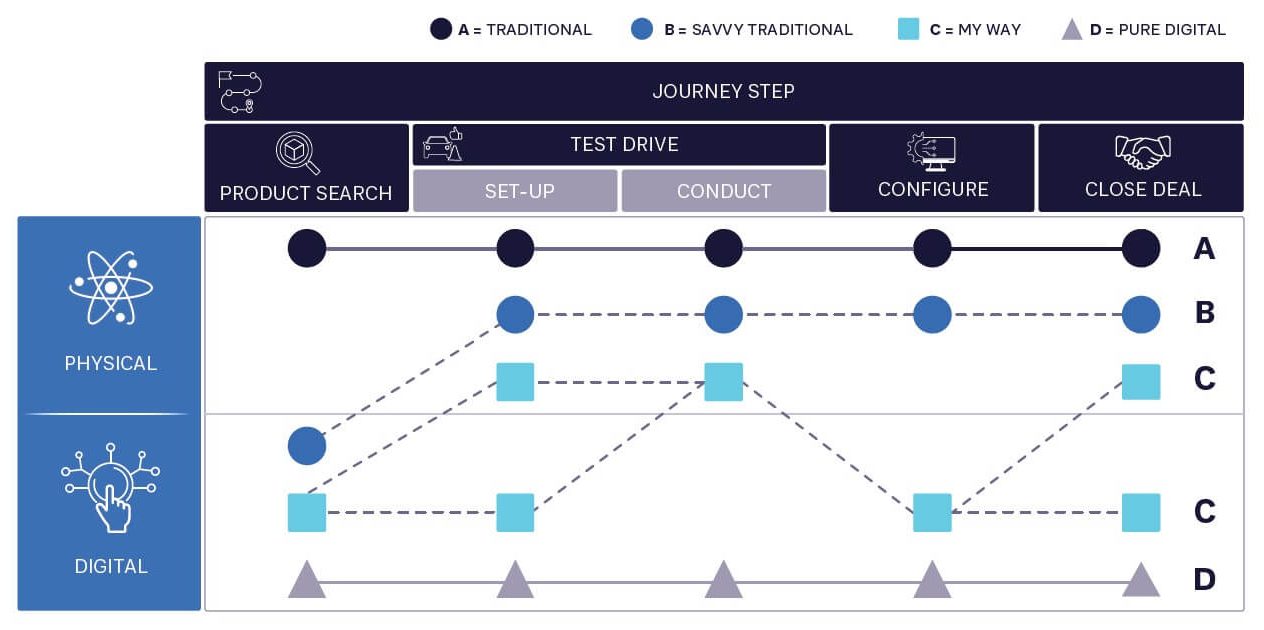
- Traditional — prefers a fully physical journey, from research to purchase.
- Savvy traditional — conducts initial research online, including available deals, but prefers in-person negotiations and interaction.
- Pure digital — prefers a predominantly online experience, handling most of the journey digitally, though some still prefer a physical closing.
- My way — representing 40% of new car buyers, this segment is characterized by diverse and complex preferences, creating hybrid physical-digital sales journeys with no standard pathway. These customers want the ability to customize their journey, choosing specific physical or digital engagement elements.
All four segments exist in all world regions but to differing extents (see Figure 2).
Figure 2. Breakdown of customer personas by region
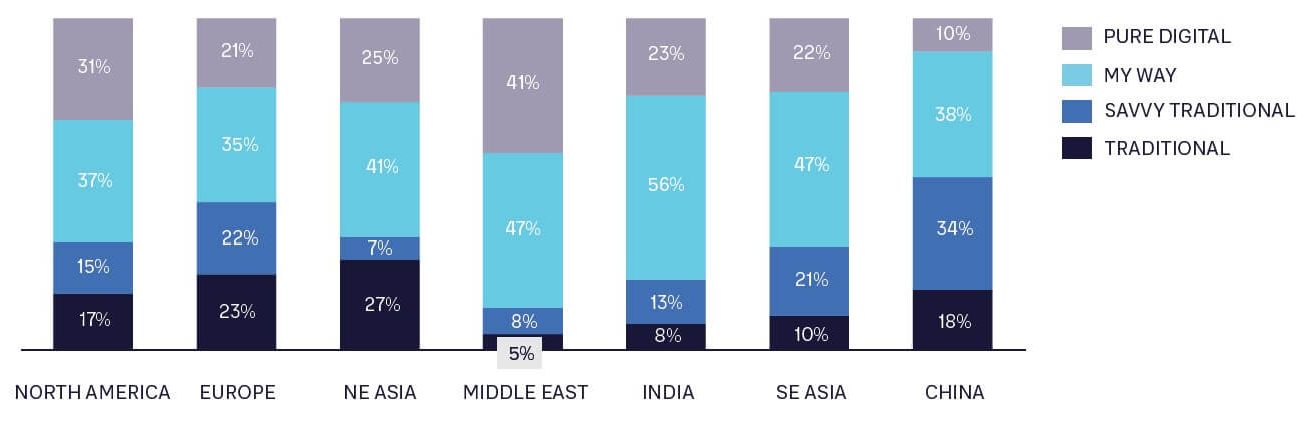
Most strikingly, customers across the regions indicate a preference for a nontraditional (either “pure digital” or “my way”) journey, with China being the exception. In the Middle East and India in particular, only 13% and 21% of customers, respectively, prefer predominantly physical customer journeys.
Building segment nuance into the sales journey
Effectively serving these diverse segments requires a nuanced approach, with segment-tailored emphases overlaid on the experience elements on which all segments agree.
Segments based on differing online versus offline sales journey preferences also vary in other ways and between regions (see Figure 3).
Figure 3. Behavioral differences between segments
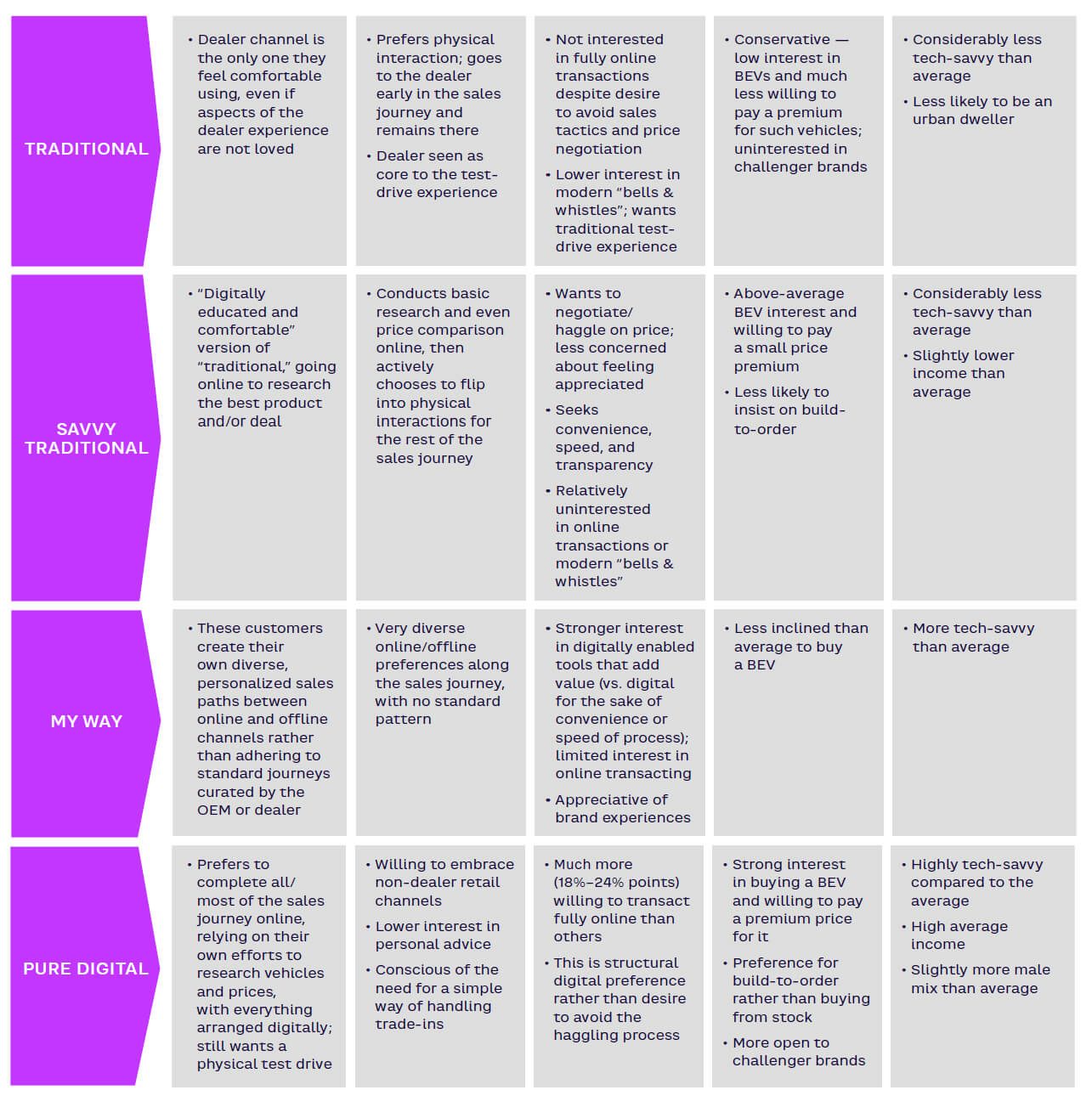
Avoiding the misconception that these differences create “open water” between segments is crucial. Instead, they represent varying degrees of emphasis. For example, while “pure digital” is more inclined to transact fully online than “traditional,” one in six traditional customers is also “very willing” to complete transactions online. Instead of removing online transactional capabilities for the traditional segment, the channel should offer a simplified version with proactive support to guide them through the process.
Traditional – Guiding the Shift to Multichannel
The traditional segment is the most familiar to the industry but will shrink over time. Customer preferences for a fully physical sales journey are often due to a lack of comfort with other approaches.
Rather than doubling down on traditional methods, the industry should focus on guiding this segment toward becoming multichannel by taking advantage of opportunities to coach the customer into digital tools and demonstrating their clear benefits, such as securing the best price without haggling.
This segment does not want heavy marketing content for unfamiliar brands. Instead, digital elements of the sales journey should be kept simple, minimizing clicks and presenting only genuinely relevant information to the customer.
Cutting-edge technologies or digitally enabled features should be used sparingly, if at all. The dealer should continue to play a core role, particularly in delivering test drives, and the sales journey should conclude with a physical close that makes customers feel valued and not pressured.
“Cutting-edge technologies or digitally enabled features should be used sparingly, if at all”
Savvy Traditional – Informed Negotiators
The savvy traditional segment has similarities with traditional, but distinct characteristics set it apart. Customers in this segment prefer to visit the dealer after conducting extensive online research, meaning they arrive well prepared and looking for the best value, which makes them highly informed deal seekers.
These customers value negotiating directly with someone who can provide meaningful discounts. They are also more willing to tolerate sales tactics or choose a vehicle from available stock to secure a better price. Any digital tools introduced for this segment should preserve their perceived ability to negotiate and haggle effectively.
A key aspect of their sales journey is the test drive, in which they prefer a low-tech experience — either with a salesperson in the passenger seat or unaccompanied. This segment is slightly more inclined than average to purchase EVs and pay a premium (versus ICEs) for them, making them a strong target for EV suppliers.
Overall, the sales journey should be crafted to help them feel they have efficiently secured the best possible deal. Process complexities should be avoided, while important physical touchpoints, such as the test drive and the final closing of the sale, should be retained.
“Traditional vertically integrated sales and distribution models, in which OEMs rely on third-party dealers to manage car buyers, are not designed around the customer”
My Way–Facilitate, Not Direct
This segment is characterized by its lack of anything approaching a standardized, preferred sales journey. It is a large segment that exhibits a much stronger than average preference for a digitally supported test drive, is more tech-savvy than average, and seeks a convenient and quick purchase process.
These customers mix and match the channel options and digital resources available to create their own sales journey. In the near term, the industry should accept this and ensure that a DIY approach results in seamless and excellent sales experiences
Pure digital — tech-savvy buyers with a preference for customization
The pure digital segment is characterized by higher technological proficiency, slightly higher-than-average income, and a more male demographic.
These customers are significantly more willing than average to complete the entire transaction online, including making payments. While securing the best possible deal is somewhat less important to them than other segments, they expect online purchasing to be inherently more cost-effective. Despite their digital preferences, they still want the option of an in-person test drive.
Their preference for digital engagement also translates into a stronger desire for build- to-order (personalized) options rather than buying from stock, with both operational and financial implications for OEMs.
They are much more interested in EVs, more willing to pay a premium for the privilege of owning one, and the most open to considering EV-focused challenger brands. All these features combine to make this segment an ideal target for new entrants that may lack a substantial physical network.
What Are OEMs Actually Doing, and what are they getting wrong?
Carmakers and dealers have not been standing still — they are adapting the new car-buying journey in three main ways.
1. New Digital Assets — Well-Intentioned but Not Customer-Centric
OEMs have invested heavily in online sales platforms and “digital showrooms,” aiming to provide interactive 3D visualizations of vehicle interiors and exteriors. Unfortunately, these tools are often laggy, unresponsive, and gimmicky — they are primarily focused on what the OEM wants customers to experience rather than providing what customers want.
A key issue is that these digital assets are centered around promoting hardware (namely, the physical vehicle), ignoring the user interfaces and software-defined vehicle features that are an increasingly crucial part of the driving experience. This oversight matters because OEMs habitually push high- tech systems onto customers, regardless of whether they are wanted. Complex and unintuitive navigation systems, intrusive safety features that cannot be easily turned off, and other high-tech elements often irritate drivers. These frustrations are rarely discovered during a brief test drive, only emerging after weeks of use and often undermining satisfaction and future loyalty.
2. Omnichannel Journeys — Siloed and Fragmented
While OEMs have embraced the concept of omnichannel retail, offering multiple ways for customers to interact with them, the reality is that omnichannel means a slightly more diverse way of ending up at the dealership, with OEM websites supplemented by third-party multi-brand portals that are limited to the early parts of the purchase journey. OEMs are wary of disrupting their dealers, meaning customers attempting to move seamlessly between physical and digital channels often find the experience disjointed. This leads to poorly connected processes and limitations in sharing customer data across businesses and the sales journey for technical and legal reasons. As a result, there is no single source of truth for the customer journey, leading to inconsistencies and further frustration.
Although some OEMs have started enabling direct sales, and leasing companies are targeting retail customers with lease offers, diversity within the retail channel is still limited.
It may be a while before customers can buy a car from the TikTok Shop (an e-commerce feature of the video-hosting service), but where customers go to buy things has irrevocably changed. Arthur D. Little data shows a growing appetite to purchase vehicles from nontraditional retail channels. This means traditional dealers must adapt their business models, cost structures, and operational footprints to accommodate a world where they may only see 40%– 50% of current sales volumes, with some customers visiting only for test drives before purchasing elsewhere
“Customers mix and match the channel options and digital resources available to create their own sales journey”
3. Agency Model — Hampered by Implementation Channels
Some car brands are shifting from franchise to agency models to reduce costs, transfer margins from dealers to OEMs, and improve the customer experience. In theory, by having the OEM set pricing centrally, the agency model offers benefits such as price transparency — desired by most — and “no haggle” sales, which are not universally welcomed across all segments.
The agency model gives OEMs greater involvement in guiding the customer through more of the sales journey, which should lead to a more consistent brand experience. However, implementation has often been problematic. OEMs, distant from the end customer and lacking direct retail expertise, sometimes create new challenges, such as limited stock availability and rigid, inflexible processes without agent discretion to overcome them. While the agency model ticks some customer-centricity boxes, poor execution can lead to significant new pain points.
The Driving Need for Customer Centricity
Comparing our research with the experience provided to car purchasers demonstrates a major, growing disconnect between OEMs and customer needs. This will damage vital sales and undermine the transition to EVs, with their very different cost lifecycles and ability to create new revenue streams such as V2G. Such gaps create opportunities for disruptors to step in and deliver a superior experience, potentially taking significant market share from traditional OEMs and their channels.
“OEMs have invested heavily in online sales platforms and 'digital showrooms,' aiming to provide interactive 3D visualizations of vehicle interiors and exteriors”
Insights for the Executive
As automotive companies and their channel partners build customer centricity, three guiding principles can be followed:
- There is no one-size-fits-all model. The segment mix varies substantially by region, making customer centricity far harder for brands with a global sales Global IT tools and processes must be flexible enough to support various journey preferences. The same applies to brand characteristics, most notably for premium versus volume brand buyers, meaning OEMs must be open to harnessing more than one commercial model.
- Understand regional differences. Whatever model OEMs adopt around becoming multiregional, a customer-centric channel and journey design must allow for regional specificities. This will typically come from ensuring a strong regional voice within the organization.
- Focus on the cement, not just the bricks. When creating modular channel configurations, focusing on the different channel bricks that can be deployed is easy. While this helps understand what needs to be built and how different steps can be delivered efficiently, focusing on the cement that holds these bricks together is more important from a customer- centricity perspective. Above all, a truly differentiated customer-centric experience will be joined up for the customer.