

14 minute read
Oct 2024
CONTRIBUTORS

Matteo Ainardi
is Managing Partner for Arthur D. Little’s Paris office, Head of the Space Center of Competence, and a member of Arthur D. Little’s board of directors.

Amaury Klossa
is a Partner and Head of the Energy & Utilities practice in Arthur D. Little’s Paris office.

Arnaud Siraudin
is an Associate Director in Arthur D. Little’s Paris office and a member of the Innovation practice.
Most would agree that technological innovation is an essential part of our response to the existential threats of climate change. Indeed, only through innovation will it be possible to achieve net zero emissions and adapt to new climate conditions while maintaining — and hopefully further improving — economic and social well-being. Yet one of the main obstacles for new and emerging climate change technologies is often their unattractiveness in terms of ROI due to factors such as risk and uncertainty, difficulty in monetizing environmental benefits, high capital outlays, and long payback periods.
Energy from space is a great example. The idea of harnessing an uninterrupted, virtually limitless source of solar energy from a device in orbit has captured the imagination since the mid-20th century, when space travel became a reality. Back in 1968, one of Arthur D. Little’s (ADL’s) leading space technology experts, Peter Glaser, published Power from the Sun: Its Future, which outlined his concept for harnessing solar energy from space, which involved deploying satellites to beam solar energy to Earth using microwaves. Despite the considerable interest at the time, the technical challenges were concluded to be too high, and there were safety concerns about the microwave-based energy transmission technology. In fact, Peter (who later became known as the “father of the solar-power satellite”) continued to work as a VP of ADL on multiple groundbreaking innovation projects, including project manager for the Apollo 11 lunar Laser Ranging Retroreflector array installed on the Moon’s surface in July 1969 and two other arrays installed during follow-on Apollo landing missions. All this hardware still functions on the Moon today.
However, the energy-from-space concept recently gained new momentum. In Pre-Phase A System Study of a Commercial-Scale Space-Based Solar Power (SBSP) System for Terrestrial Needs – ADL, working with partners Thales Alenia Space France, Dassault Aviation, Engie, and Air Liquide, has, in a sense, returned “back to the future” of energy from space with a new study for the European Space Agency (ESA) on direct solar reflection (DSR). Rather than generating energy from the Sun in space and using microwaves to transmit it to a fixed base station on Earth, DSR involves deploying a constellation of mirrors in space to reflect sunlight directly onto a range of Earth-based solar farms, acting like an additional sun for them. DSR is still at the concept stage, but initial deployments could happen as early as 2035.
The sudden acceleration of the DSR concept illustrates some key lessons for harnessing innovation to achieve sustainability goals. It’s also a fascinating project in its own right.
How DSR works
Global installed solar photovoltaic (PV) continues to be one of the fastest-growing green energy technologies, reaching around 2,000 gigawatts (GW) in 2024. However, solar farms only produce energy when the sun is shining and high in the sky. DSR involves deploying large mirrors in space that redirect the sun’s energy on the ground toward existing or new PV plants to increase their illumination, especially when there is no (or not enough) sun (see Figure 1).
CONTRIBUTORS
Matteo Ainardi
is Managing Partner for Arthur D. Little’s Paris office, Head of the Space Center of Competence, and a member of Arthur D. Little’s board of directors.
Amaury Klossa
is a Partner and Head of the Energy & Utilities practice in Arthur D. Little’s Paris office.
Arnaud Siraudin
is an Associate Director in Arthur D. Little’s Paris office and a member of the Innovation practice.
Figure 1. DSR concept
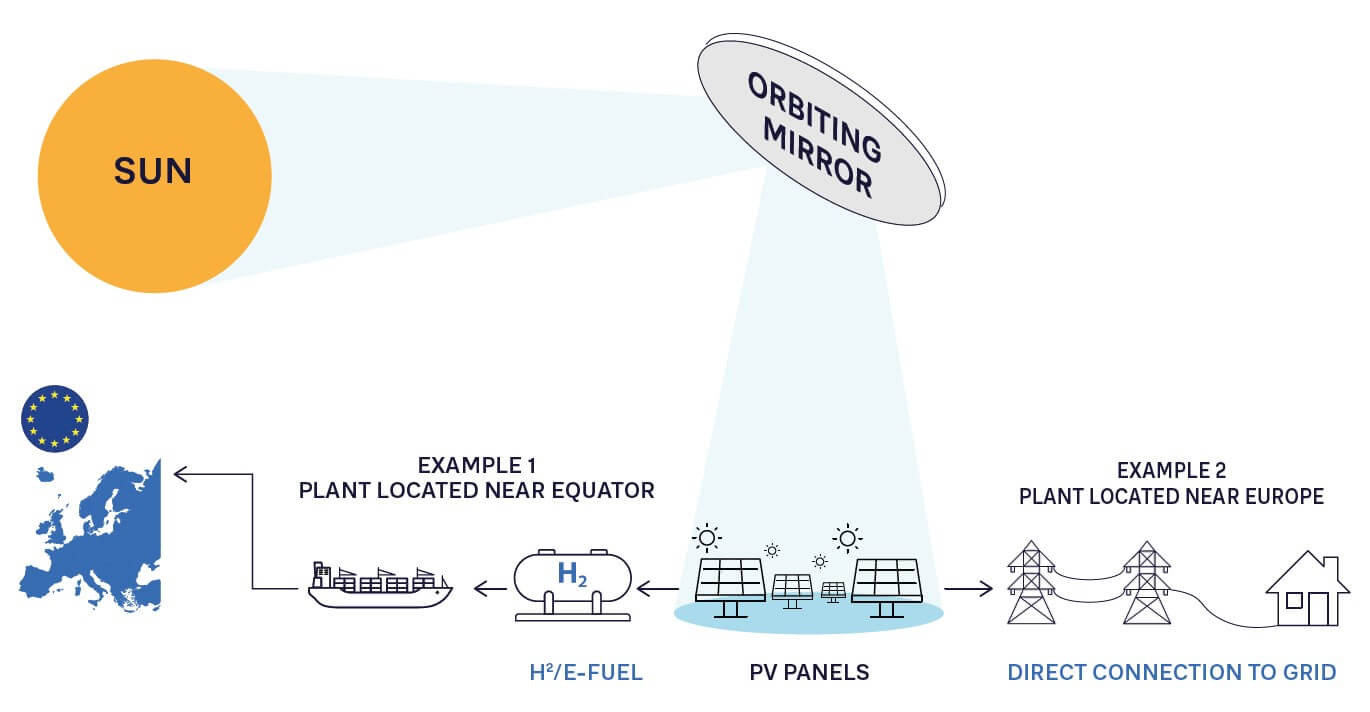
The mirrors can be placed in low Earth orbit, potentially adding up to two extra hours of peak sunlight per day, at dawn and dusk. This leads to a significant increase in energy production from solar farms — as much as 60% annually near the equator — greatly improving their overall efficiency.
The technology concept examined to date involves deploying into space an array of 4,000 mirrors, each approximately 1 km in diameter, at an orbit altitude of 890 km. The orientation of the mirrors is automatically controlled to illuminate a spot on the Earth’s surface that is approximately 8 km in diameter. The array is given an orbital path around Earth that enables it to cover many ground-based solar farms. (The concept evaluation considered 30 such farms.) The array covers each solar farm’s dawn and dusk hours before moving on to the next one along the orbital path. To prevent the “solar spotlight” from the array from affecting any populated areas, a clear space with a diameter of 15-20 km would be needed around each solar farm. This means that many of the likely solar farm candidates for DSR would be off-grid. Indeed, many of the world’s largest solar farms located near the equator, now and in the future, are or will be off-grid. Instead of delivering electricity, they produce green hydrogen, which is shipped by pipeline or boat to commercial or industrial customers. Today, hydrogen is produced from a solar PV farm by using the power to electrolyze water — this is the typical way of transmitting the energy produced when a direct grid connection is not feasible – emerging technologies such as solar fuel cells could generate hydrogen directly from solar energy, without the use of electricity in the process, leading to triple the yield rate.
DSR is one of two energy-from-space concepts currently being explored. The other one, known as “space-based solar power (SBSP),” involves deploying a 7 km x 5 km solar PV factory into geostationary orbit. The space-based PV array would transmit an uninterrupted energy supply via microwaves to a fixed ground station on Earth. SBSP is best seen as a complement to DSR. They have different objectives: DSR aims to better exploit the huge financial and material investments already being made into solar farms on earth, while SBPS aims to provide a completely new source of baseload power.
“The technology concept examined to date involves deploying into space an array of 4,000 mirrors, each approximately 1km in diameter, at an orbit altitude of 890km”
The value proposition of DSR
The key question, of course, is whether the economics of DSR are attractive enough. The work done so far on the concept concludes that it could be attractive; however, like some other new energy technologies, it requires a high up-front investment. We can consider the value proposition from the perspectives of environmental benefits, ground-based energy operators, and space operators.
DSR has a strong, positive environmental impact
DSR infrastructure at full scale is estimated to avoid around 8.8 billion tons of carbon emissions over a 30-year operational period, compared to what would be emitted by a gas-fired power station to generate the same amount of energy without it. To compare, according to the European Environment Agency (EEA)Trends and Projections in Europe 2023 report, EU countries currently emit just under 3 billion tons of greenhouse gas per annum.4 Against this, we need to account for the carbon footprint of DSR operations, which is dominated by the launch phase. Overall, approximately 85 million tons of CO2 are emitted over the project lifetime, yielding a net CO2 benefit of around 8.7 billion tons. Carbon neutrality would be reached around five years after launch.
DSR has an insignificant energy footprint compared to its energy production capacity. In the reference scenario, around 20,400 terawatt hours (TWh) are produced over the project lifetime versus only around 300 TWh needed for launch, satellite production, and deployment. At full scale, 18 million tons of hydrogen would be produced annually, more than 10% of the projected European consumption in 2050.
DSR can deliver substantial value to ground energy operators
Once the original capital outlay has been made, DSR could provide up to 60% of additional energy output from each solar farm it services, without the need for additional CAPEX. If we consider the case of a single PV+electrolyzer station with an installed capacity of 8.8 gigawatt peak (GWp), generating this amount of additional energy would require US $5 billion of capital investment. This $5 billion saving means the operator could decrease its hydrogen production cost (LCOH) – which is LCOH is the price per unit of hydrogen that operators need to charge customers in order to break even – by 50%. Even if the DSR provider charges a transfer price for the additional energy, the operator would still have a large net margin.
Further gains could occur if and when solar fuel cell (SFC) technology becomes available. SFC converts solar energy directly to hydrogen without generating electricity as an intermediate step. SFC increases the efficiency of green hydrogen production from 12% to around 40%.
DSR could be profitable for space operators
For the concept to be feasible, the technology must also be profitable for the space operator managing the DSR constellation. Some 80% of the investment needed is for launch and deployment, the costs for which depend on the array’s size and scale. For the 4,000 mirrors needed to reach 1,000W/m2 – the power provided by the Sun at noon – the investment would be around $60 billion. Reducing the size of the array lowers the cost, but the study calculated that an array of at least 800 mirrors is needed to provide a competitive green hydrogen generation cost. This may be considered, therefore, a minimum viable product (MVP), which would reduce the investment to $10–$13 billion and the same level of revenue over the period for the space operator.
Some key challenges to be addressed
Meeting pressures to decarbonize transport
As with any developing technology, there are some challenges to making DSR a reality, but in theory, at least, these seem to be within reach:
- Technical: DSR is significantly less complex than SBSP, and most of the technologies it relies on are mature or almost mature. Challenges still to be overcome include mirror deployment, attitude control, mirror production capacity, and development of earth- based solar fuel cells. A further challenge is ensuring safe and sustainable operation. Collision with space debris is an issue for any hardware deployment in space, particularly space infrastructures deployed in low orbits. We could expect to launch the first small- scale mirror into orbit as a demonstrator in less than two years to prove the technical feasibility of deployment and attitude control. The DSR technology is also modular, so it could be further developed in stages to start operating with five mirrors as early as 2035 to prove that these technical issues can be tackled.
- Financial: The main challenge here is the initial capital investment to deploy an MVP, which, as we have seen, is at least $10 billion. This would likely require several stakeholders, including space agencies, governments, and private funders. Space agencies are generally strongly motivated to pursue energy-from-space projects as they benefit humans on Earth directly. Governments are often interested in catalyzing the creation of new value chains, as many have tried to do for nuclear projects. Regions such as the Arabian Gulf, India, North Africa, and Australia, with their large, empty, sun-baked spaces, may especially be interested. From a private funding perspective, even if the payback period for a full-scale DSR deployment may not be so attractive per se, investment in the technology bricks that enable it (e.g., mirror and coating technologies, control systems, and remote robotics for assembly and maintenance) have broad applications and could create value in much shorter timescales.
- Deployment: The excessive cost of deployment used to be the main barrier for energy-from-space concepts. However, since the 1980s, the cost per kg for space deployment has plummeted from $60,000 to $2,300 today. The SpaceX roadmap envisages an even more dramatic decrease, with the Starship launcher claiming to reach $100 per kg in the short term. Europe is considering developing a similar launcher. This means deploying 800 mirrors (the MVP case) could be feasible by 2035, with 4,000 mirrors by 2043.
- Public acceptance: Current public opinion is concerned about the risks of deploying technology in space, from the point of view of space pollution, accidents, and any unexpected complex adverse effects from what might be seen as “geoengineering.” DSR has the benefit of being inherently safe (for example, the radiation from an array is not harmful to humans within the “spotlight”) and is localized in its impact, with very low light pollution. This would be further confirmed in the early deployment phases of the project.
“A further risk that needs to be controlled is collision with space debris, an issue for any hardware deployment in space, particularly for space infrastructures deployed in low orbits”
Some lessons on innovating for sustainability
The acceleration of the DSR concept in terms of technical feasibility and attractiveness illustrates the following five important lessons about innovating for sustainability.
1. Assumptions about technology performance and risk need to be constantly revisited
Energy from space has been considered a risky, uncertain concept for decades. Some energy operators perceive it at the same level of uncertainty and risk as nuclear fusion. However, individual breakthroughs on the technological bricks needed for energy from space have continued to the point where, collectively, what seemed unfeasible is now becoming feasible — examples include progress made on super-heavy launchers to reduce cost per kilogram, new ultra- thin and low-weight reflector materials, better robotization for deployment, and greater attitude-control accuracy. It is important to continuously challenge preconceptions and assumptions, which can be quickly overturned when stepwise progress reaches a tipping point. This often occurs by leveraging ongoing innovations and new use cases in adjacent, or even completely unconnected, domains.
“Energy from space has been considered a risky, uncertain concept for decades. Some energy operators perceive it at the same level of uncertainty and risk as nuclear fusion”
2. Collaboration across traditional boundaries is critical for innovation to address sustainability challenges
Energy-from-space innovations such as DSR are only possible with convergence between two separate value chains: space and energy. Space and energy traditionally operate in completely different worlds, with different technologies, economics, markets, customers, and ways of working. Beyond energy from space, many climate mitigation and adaptation challenges require convergence between diverse sectors and stakeholders, such as space and agriculture for crop monitoring and space and telecoms for maritime communications (to optimize boats’ fuel consumption, for instance). Climate change adaptation also depends heavily on finding new ways to collaborate between governments, local communities, businesses, and individuals to combine local, national, and global system-level interests and challenges. A new mindset is needed that is willing to set aside reluctance to expose intentions and constraints in the interests of collaboration.
3. New approaches to ecosystem working are needed to drive this type of innovation
For these extended, diverse ecosystems to be established and operate effectively, new approaches are needed. For example, the DSR project involves energy players, space players, public authorities, and investors. Establishing an independent orchestration role can be key to making this work. The orchestrator acts as an unbiased party to encourage open information sharing to help in “translation” for better communication and understanding between diverse players, to be a trusted resource to research the necessary evidence to answer key questions, and to resolve differences of opinion.
4. Multiple parallel technology approaches need to be pursued to improve the likelihood of success in addressing sustainability
While the idea of a balanced portfolio of technology development projects is well established within companies’ R&D departments, this is less the case on a global scale. For example, there has been a tendency at national levels to compare DSR with SBSP technologies to decide which to fund. In fact, the two concepts deliver completely different outcomes and are wholly complementary to each other.
To tackle challenges on the scale of global sustainability, multiple technologies must be pursued at the level of a global “portfolio.” Space technologies can become mature by leveraging short-term use cases on Earth. For example, radio frequency power beaming technology (such as that envisaged for SBSP) could have exciting terrestrial use cases, such as providing energy to planes or drones or connecting electricity grids without cables.
5. Financing innovation for sustainability needs different strategies
The initial outlays for sustainability-related projects such as DSR and SBSP are very large, so financing is challenging, even with a positive ROI. The initial investments are beyond the capacity of all but the largest public sources, and the payback periods of 15–20 years are too long for private funders. This means that innovative financing approaches involving public and private funding, such as green bonds, should be considered. A second strategy is to focus first on developing some of the technology bricks rather than the whole system, which can often be done with other more attractive use cases — even if the system integration afterward becomes more complex.
Ultimately, the severity of the sustainability challenge may force new levels of global collaboration, but our aim should be to establish this collaboration before catastrophic events impose it on us. Managing the ecosystem is the last, but certainly not the least, challenge to overcome to make energy from space a reality for the benefit of humanity.
“Energy-from-space innovations such as DSR are only possible with convergence between two separate value chains: space and energy”