


14 minute read
Apr 2025
CONTRIBUTORS

Florence Carlot
Partner, Energy, Utilities & Resources

Sam Clauwaert
is a Principal in Arthur D. Little’s Brussels office and a member of the Energy, Utilities & Resources practice.

Victor Debray
is a Consultant in Arthur D. Little’s Brussels office and a member of the Energy, Utilities & Resources practice.
The rise of renewable energy and the need to decarbonize are radically reshaping the energy sector across Europe, the US, and Australasia. Rather than being passive participants at the end of a top-down energy value chain, business-to-business (B2B) and business-to-consumer (B2C) customers are now part of a decentralized, interlinked ecosystem, not just consuming but also generating and selling power from their own solar panels and wind turbines.
Consumption patterns are also radically changing with the rise of high-demand, controllable technologies such as electric vehicles (EVs), batteries, and heat pumps. Smart meters now provide crucial data to monitor, plan, and predict future needs.
Retail energy utilities, which have traditionally been closest to the customer, initially felt this ongoing shift the most and are now transforming to become more customer centric. However, the need for transformation now impacts the entire supply chain, notably distribution system operators (DSOs), which provide power to customers, and grid transmission system operators (TSOs), which are responsible for the security of supply and demand at high- and medium-voltage levels. All need to build relationships and engage with end consumers if they are to provide the right services, keep the lights on at a time of growing demand, and decarbonize the entire energy system.
This transformative shift presents both challenges and opportunities across the energy value chain, particularly for organizations that have never had a direct relationship with customers. How can all players move from an asset-centric to a customer-centric model?
Drivers for Customer Centricity
Ensuring a sufficient supply of green, decarbonized energy is essential to achieve net-zero goals, meet increased demands for power in an electrified world, and ensure that traditional fossil fuel generation is removed from the energy mix. Delivering on these requires focusing on the end customer, putting them at the heart of a successful shift to a green energy system. The following six key trends are driving this change.
1. Need to Balance Centralized and Decentralized Assets
The old-style centralized, unidirectional model, which saw a small number of large-scale power stations generating power that was then supplied to consumers via transmission and distribution networks, is increasingly a thing of the past. Instead, consumers are generating their own power from renewable distributed sources, potentially selling any surplus back to the grid while adopting EVs and more efficient forms of heating, such as heating pumps. According to the International Energy Agency (IEA), installed solar capacity has grown by 22% in the EU since 2010, much of it in individual homes.
Grid companies, in particular, need to encourage local, decentralized energy generation by customers. This helps mitigate growing network congestion, which can otherwise only be solved through large-scale investments in potentially unpopular infrastructure.
CONTRIBUTORS
Florence Carlot
Partner, Energy, Utilities & Resources
Sam Clauwaert
is a Principal in Arthur D. Little’s Brussels office and a member of the Energy, Utilities & Resources practice.
Victor Debray
is a Consultant in Arthur D. Little’s Brussels office and a member of the Energy, Utilities & Resources practice.
2. Technology and Data Advances
Smart meter penetration rose to over 80% in the US by the end of 2023, with rates in Europe expected to hit 76% by 2028, according to analysts Berg Insight. Combined with behind-the-meter Internet of Things devices, this is transforming usage data availability to consumers, utilities, and transmission/grid operators. Using data analytics and AI capabilities, smart meter data gives detailed insights into energy requirements, providing the ability to potentially reshape demand as required. For example, in the UK, grid operator National Grid incentivized 2.6 million households and consumers to reduce their energy demands during times of low production in winter 2023/2024, ensuring the availability of sufficient power across the country.
3. Regulatory Pressure
The need to meet net-zero targets is driving regulators to mandate greater energy efficiency through tighter standards and remove fossil fuel generation. According to the European Commission’s Energy Efficiency Targets, the EU aims to reduce energy consumption by 11.7% by 2030 compared to its 2020 Reference Scenario. Regulators are focusing on mobilizing customers to drive decarbonization by forcing retailers to offer dynamic pricing tariffs as well as providing direct access to plugged-in EVs, enabling usage for their batteries when the grid is under tension.
“Smart meters now provide crucial data to monitor, plan, and predict future needs”
4. Demand for Sustainability
The impacts of climate change and growing environmental awareness are driving a need to generate more sustainable energy. This brings opportunities for energy players to directly support customers, such as through the supply of solar panels and home EV charging facilities, and new challenges to the network regarding additional connections to grids that are often already operating close to capacity.
5. Rising Energy Poverty
Growing prices and poor housing energy efficiency are increasing the burden of energy costs, particularly on those who cannot afford to buy and install their own renewable resources or improve their home’s energy performance. Regulators are demanding meeting the specific needs of these users through tailored plans and support, but overall numbers are growing. For example, the amount of registered protected energy users in the Brussels region has grown by 252% over the last five years, according to the “Energy Poverty Barometer” published by the King Baudouin Foundation.
“Using data analytics and AI capabilities, smart meter data gives detailed insights into energy requirements, providing the ability to potentially reshape demand as required”
6. Growing Competition from New, Customer-Centric Players
Retail energy suppliers face growing competition from nontraditional rivals. These could be new energy-specific players, such as Octopus Energy in the UK, which has built strong brand positioning around a focus on sustainable energy and effective, digital-first customer service. Alternatively, companies from outside the energy sector, such as telcos and automotive OEMs, are now able to leverage their brands to deliver a range of high-value, high-margin products and services to customers, leaving existing suppliers to compete for lower-margin, commodity services.
How Energy Players Should Respond to the changing environment
Energy players, from grid companies to retail suppliers, have understood the need to change for many years but can struggle to move from concept and strategy to actual transformation. They must organize effectively to serve the customer with a clear strategy and roadmap that addresses the key drivers explained above and focuses on three objectives:
- Customer service ambition. What services should they develop to meet customer needs and demand while navigating regulatory constraints?
- Clear customer and stakeholder definition. How should customers be segmented to serve their needs optimally, and which additional stakeholders should be engaged to reach and support them?
- Internal and external enablers. How should they organize internally and within their ecosystem to deliver services to targeted customer segments effectively?
Customer Service Ambition—Prioritize the Right Services
Decentralization and the energy transition are changing what customers expect from their utilities and, therefore, the services companies must offer. For instance, the value of energy transition-related products and services, such as solar panels and battery storage, is expected to grow significantly in the EU over the next decades (see Figure 1). This growth presents a major opportunity for commercial entities to diversify their revenue streams. However, it also significantly impacts grid operators, requiring them to rethink their integration into the network.
Figure 1. Growth and impact of adjacent energy products
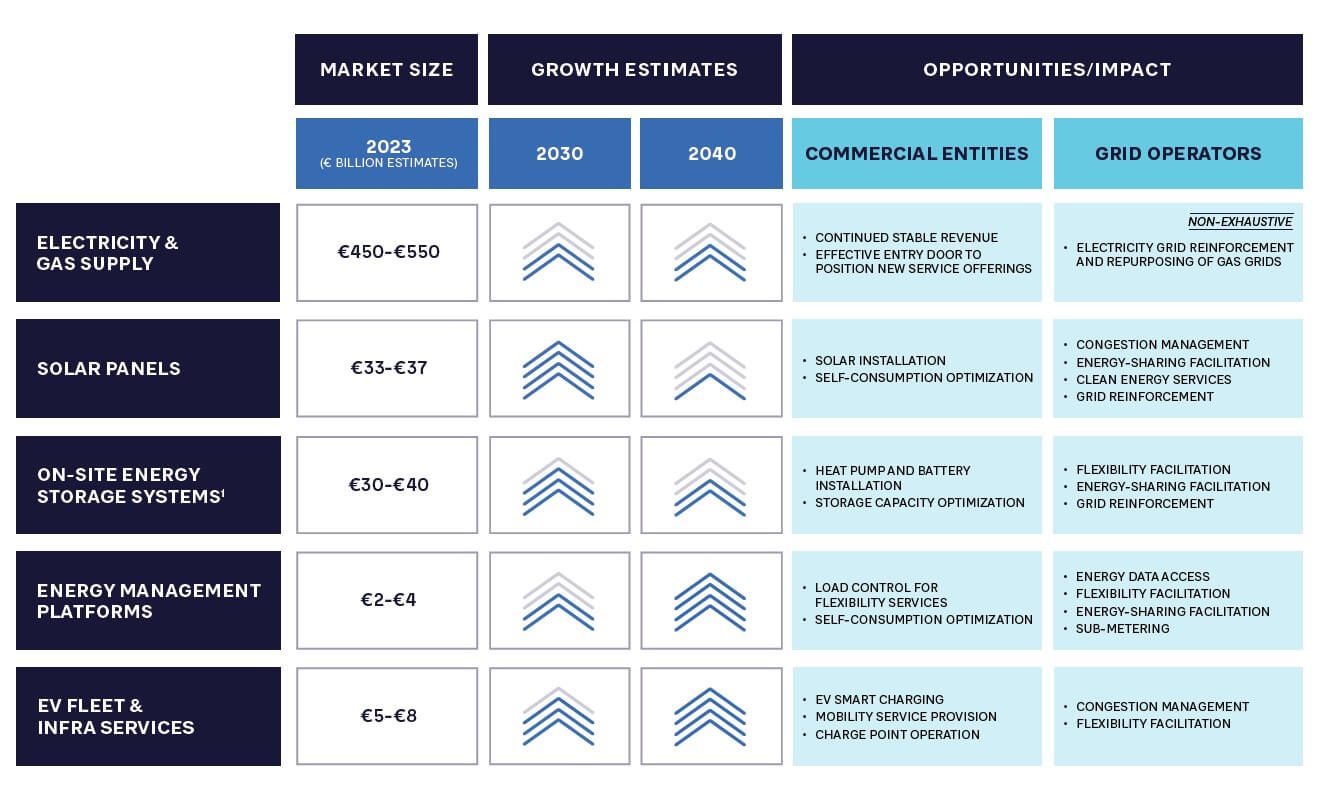
Retail utilities must move beyond traditional commodity-based offerings to provide energy services, including renewable energy consultancy, EV support services, and energy-efficiency support. These should enable customers to maximize self-consumption, monetize their assets, and reduce exposure to energy market volatility. Delivered effectively, they create a platform for meaningful customer partnerships, delivering personalized services that optimize customer lifetime value.
Driven by electrification and technological advancements, the volume of energy data has surged. Grid companies should become key facilitators in efficiently and securely sharing this data, enabling new energy transition products and services, and facilitating the energy transition. That means expanding traditional services, such as new grid connections and technical work due to the deployment of new solar panels, charging points, and batteries.
At the same time, grid companies must develop new services, such as clean energy/energy efficiency. They should also increase grid flexibility by enhancing their capabilities around congestion forecasting, trading flexibility products, and compensating flexibility service providers while developing new energy carriers such as hydrogen.
Overall, the evolving customer journey means customers will have more frequent interactions with grid operators, necessitating the development of digital and self-service channels for efficient management. Grid operators should inform and educate the public on important topics such as smart meter rollouts and related customer opportunities, energy sharing, and sustainable energy practices to ensure inclusiveness in the energy transition.
“The impacts of climate change and growing environmental awareness are driving a need to generate more sustainable energy”
Clear Customer and Stakeholder Definition—Reconsider Segments in line with targeted services
The increasingly complex energy ecosystem requires utilities to consider a growing number of commercial and noncommercial stakeholders to effectively carry out their activities. Customer strategy should encompass all stakeholders influencing or facilitating the consumer’s energy-related activities. For instance, while an apartment owner is a customer for a grid operator, engaging with building managers is equally important when there’s a need for new grid connections, such as for an EV. Figure 2 illustrates the energy user as the customer alongside the key relevant stakeholders to consider when shaping customer strategy.
Figure 2. Stakeholders to consider when shaping a customer strategy
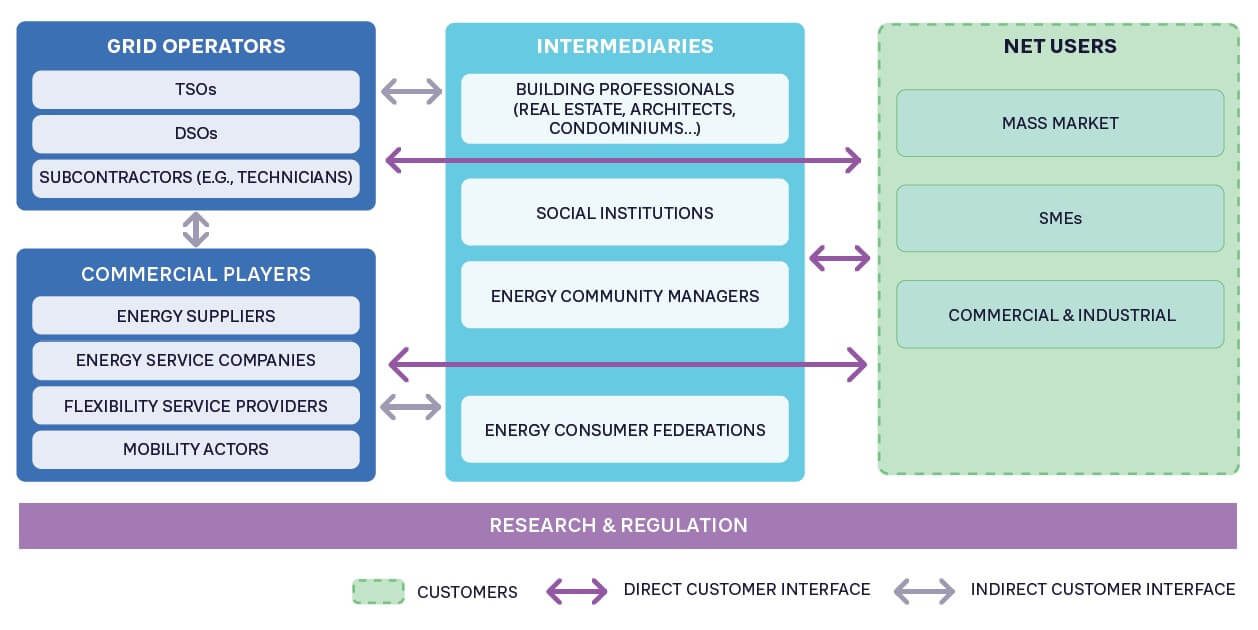
While utilities worldwide adopt the traditional segmentation approach of energy users into mass market, small and medium-sized enterprises, and commercial and industrial, this approach is becoming suboptimal given rapidly evolving customer characteristics. For example, previously, the number of customers with distributed energy resources, smart meters, and flexible capacity was limited. Today, this population is growing significantly, presenting new opportunities and challenges.
Utilities should start by analyzing evolving customer needs and characteristics while understanding how to leverage other stakeholders (intermediaries in Figure 2) to deliver customer services. For example, when a utility provides services to a housing intermediary, it is indirectly serving the building tenant, thus the net user. Based on this, some intermediary groups could also be identified as segments for delivering specific services.
Internal and External Enablers — Implement Transformation to build a Customer Centric Organization
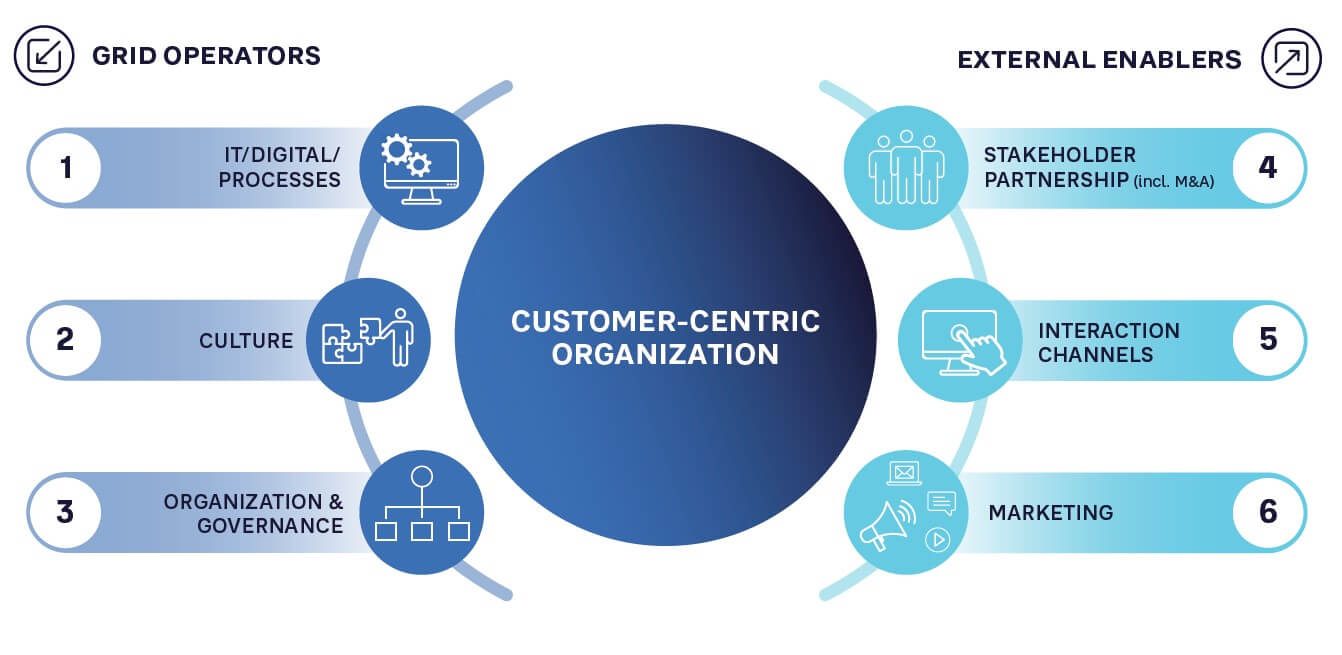
Once a company has clearly defined its customer service offerings and segments, it must structure itself for efficient delivery. Six key enablers can drive the necessary organizational change (see Figure 3). Internal enablers focus on changes within the organization, while external enablers address its connections with the broader ecosystem.
Figure 3. Enablers to drive organizational change
Internal Enablers
- IT/digital processes. According to the Energy Retailers’ Business Model, organizations should build a strong technology stack, ensuring they have a complete set of features across front-office (customer engagement channels) and back- office (billing, metering, customer relationship management [CRM], enterprise resource planning) applications in line with customer needs and expectations.2 To maximize internal and external reuse, minimize customization, and optimize the total cost of ownership, they should adopt modern architectures that are cloud- and component-based, modular, integrated by microservices, and loosely coupled to connect customer-relevant features. Additionally, they need to invest in efficient and secure management and sharing of (smart meter) energy data to develop new energy transition-related services and increase ecosystem collaboration. Finally, they should focus on enabling new services with emerging technologies, such as AI-powered engagement, which can capitalize on a wide range of customer data.
- Culture. Changing culture is key and must be embedded across the organization. Start by infusing a customer-centric mindset early in the employee journey by highlighting its importance in job descriptions and onboarding activities. Provide general and specific training and cross-department shadowing to deliver customer-oriented learning opportunities across the entire organization. Cultural change is an ongoing process, so organizations must implement an internal communication strategy, recognize customer-centric achievements, and integrate visual elements within the office space to sustain constant awareness of the customer’s importance and integrate customer centricity as part of the leadership journey. To accelerate progress, measure customer-related KPIs, make them visible to the whole organization, and incentivize employees by tying variable remuneration to these metrics.
- Organization and governance. Reimagine traditional structures and hierarchies to focus on customer excellence and enable the agility to respond successfully to fast-evolving customer needs. As part of this, organizations should formalize transversal collaboration around customer centricity by bringing together multiple departments to effectively identify and drive new customer opportunities, especially around specific customer segments, including relevant intermediaries.
“Cultural change is an ongoing process, so organizations must implement an internal communication strategy”
External Enablers
- Stakeholders and partnerships (including M&As). Utilities need to move beyond traditional partners and focus increasingly on ecosystem collaboration, such as with OEMs, car dealers, energy service companies, and flexibility providers, as well as leveraging building professionals and housing intermediaries to increase B2C reach, specifically focusing on energy transition topics. Delivering the right information is key — utilities should streamline communication to allow the customer to transparently and effectively navigate their energy investments while also collaborating with relevant stakeholders to improve reach when informing customers about the opportunities the energy transition brings.
- Interaction channels. Utilities should optimize their reach by providing self-explanatory information through traditional and advanced interaction channels while orienting/guiding customers toward a digital-first future. On the customer service side, they must promote “right first time” resolution by providing two-way interaction channels and investing in training for frontline agent enablement, including field personnel. They should implement more flexible and responsive CRM, field service, and AI knowledge management solutions to support this. They should also invest in self-service-enabled interaction by further developing B2C/B2B portals and mobile apps and investing in AI agents as frontline customer support.
- Marketing. Energy retailers need to focus their marketing activities on promoting brand visibility and shift their focus toward customer partnership models. For grid companies, the emphasis should be on demystifying installation requirements for distributed energy resources, activating net users to support increasingly congested grids, unlocking smart meter capabilities, and increasing overall reach. Communication should involve simple, intuitive, and tailored messaging per target group within a segment (e.g., EV owners, customers with solar photovoltaics, and customers with a high energy consumption footprint), given the complexity and wide range of energy transition opportunities potentially impacting customers. It’s important to replicate key messages through all customer touchpoints (e.g., call centers, technicians, and sales reps) and intermediaries (e.g., car dealers and housing agencies) to generate traction. To achieve optimal reach and ensure the energy transition reaches all groups, utilities should also deploy highly visible physical marketing assets “in the street,” such as billboards, messaging on their vehicles, and digital signage at transport hubs.
“Energy retailers need to focus their marketing activities on promoting brand visibility and shift their focus toward customer partnership models”
Case study — Enel X & Volkswagen
Italian energy supplier Enel X has created a joint venture (JV) charging point operator with Volkswagen to enhance EV uptake. The JV has invested in deploying, owning, and operating a high-power charging network of more than 3,000 charging points across Italy. Enel X further supports the JV with service contracts to make its e-mobility technology and expertise available during the start-up phase while collaborating with leasing companies and software providers to serve as electric mobility service providers.
Insights for the Executive
As the energy landscape becomes more decentralized, suppliers and grid companies should focus on a customer-centric approach through the following actions:
- For retailers, decommoditization, convergence, convenience, and optimizing cost-to-serve should be central to business strategy.
- Diversify business models toward partnership models, shifting from short-term value gain to optimizing customer lifetime value, such as through benefit-sharing models.
- Increasingly focus on ecosystem collaboration beyond traditional partners and leverage intermediaries such as building managers.
- Focus on data, managing and sharing it securely and efficiently to develop new services and expand ecosystem collaboration.
- Establish processes for bringing together cross-functional teams from across the business to create new customer- focused services and improvements.
- Foster a customer-centric culture by embedding it from the beginning of employee and leadership journeys and making it tangible through success stories, measuring effectiveness and adapting compensation programs accordingly.
- Sharpen digital consumer operations (especially via AI) to improve consumer engagement and satisfaction and reduce cost-to-serve. Ensure your interaction channel strategy aims to optimize reachability, promotes “right first time” resolution, and provides self-service-enabled interactions, specifically focusing on fast-changing AI capabilities.