


14 minute read
Apr 2026

How AI Is Changing the Game for Retailers




Shopping with AI is intensely personal — a one-on-one conversation with an all-knowing companion. But this solo era may already be coming to an end.
My hair dryer died recently. I did what a growing number of consumers now do: I opened ChatGPT. Not Google. Not Amazon. Not the beauty retailer down the road. My hairdresser had suggested the Dyson Airwrap, but I didn’t want to spend that much on a styling tool I’d use a few times a week. So I talked it through with AI — my preferences, my budget, what I actually needed versus what I didn’t. It recommended the Shark Glossi, a product I’d never heard of. I read the reviews it surfaced — not from hair influencers on YouTube but from people who sounded more like me. Fifteen minutes later, I’d made my decision. During the entire process, I visited a retailer’s website only to complete the purchase.
The retailer made the sale but never had the chance to show me alternatives, serve an ad, or shape my consideration set. That entire upper-funnel journey — discovery, research, evaluation — happened in a private conversation with an AI assistant that knows my history and adapts to my preferences. This is the defining feature of shopping in the AI era (see Arthur D. Little [ADL] Viewpoint “Retail & AI: Accelerating the Scale-Up”). Unlike search (impersonal, transactional) or social media (performative, communal), shopping with AI is a private, evolving conversation. Every purchasing input is filtered through a single, evolving relationship with a companion, narrowing choices to three options instead of 300.
This matters for every executive whose business touches consumer markets. In a 2025 article examining how AI agents interact with retail environments, ADL researchers found that these systems are already reshaping how products are discovered, evaluated, and purchased — often in ways invisible to the retailers and brands involved (see Amplify article “Agentic AI Wants to Eat Your Lunchtime Meal Deal”).
THE SHADOW SHOPPING ECONOMY
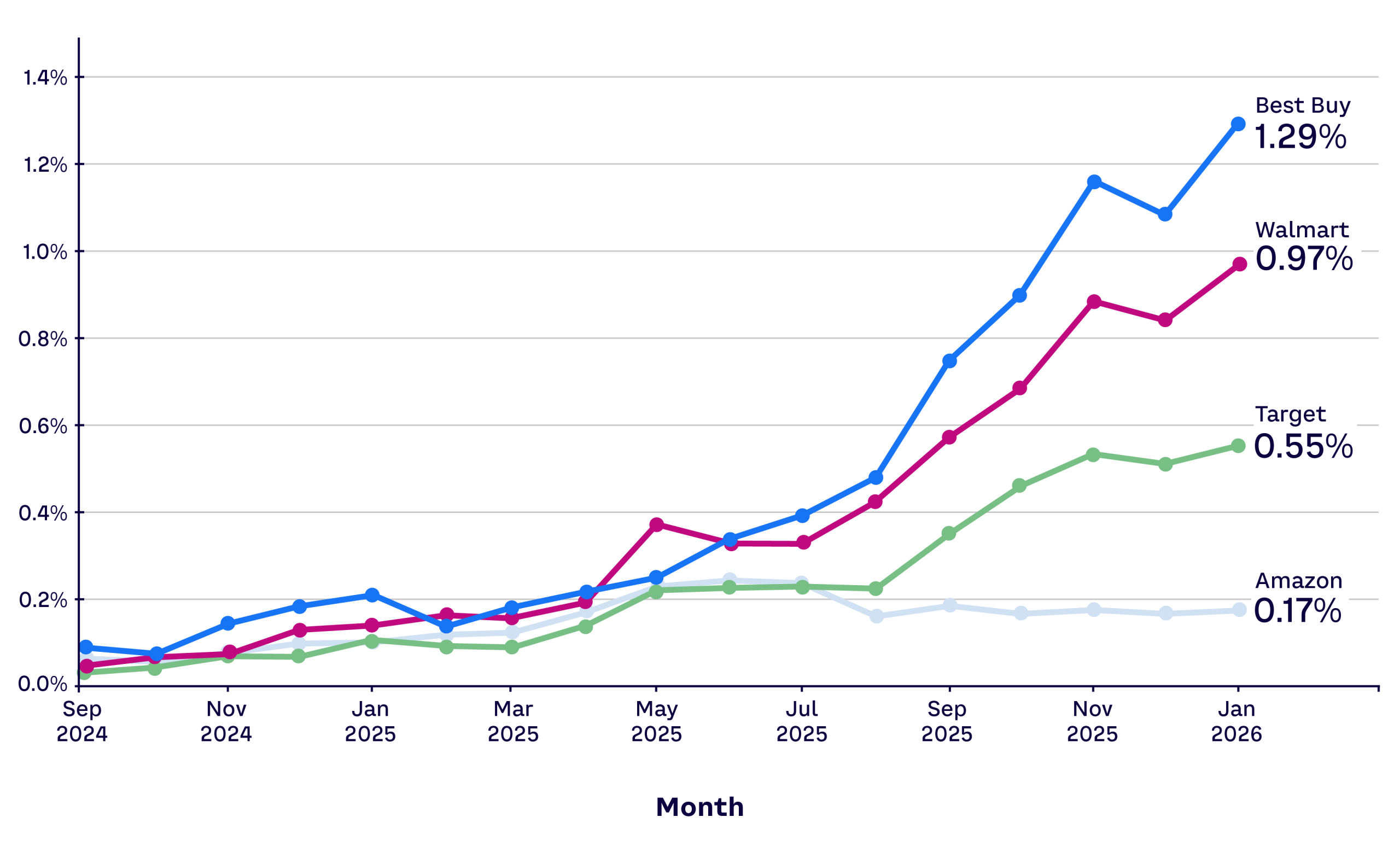
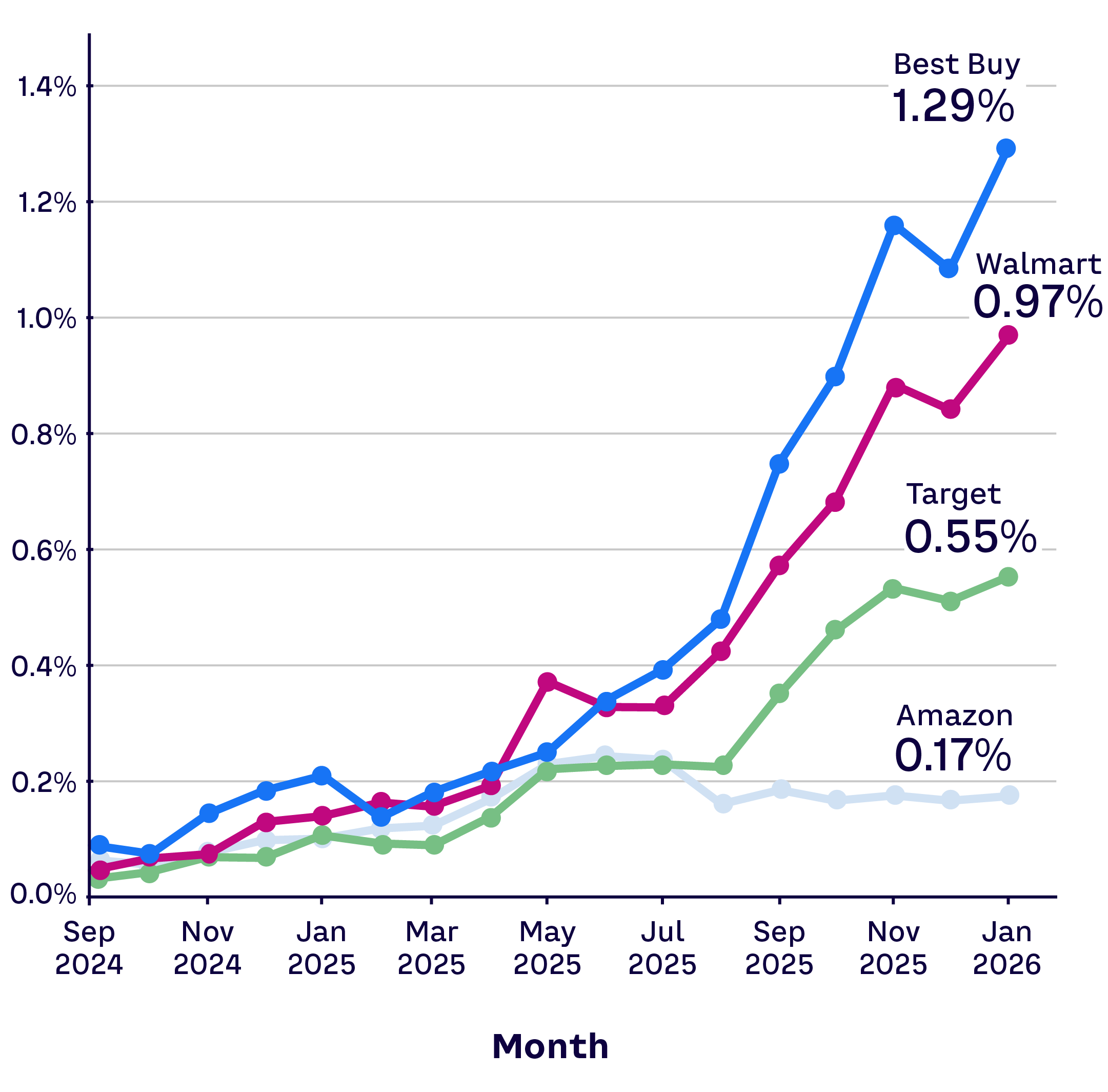
The shift is already measurable, if still modest in scale. Research firm Sensor Tower collected traffic data across four major US retailers (Walmart, Amazon, Target, and Best Buy), which shows generative AI (GenAI) referrals growing every month since tracking began in September 2024. Walmart’s GenAI traffic share grew roughly twentyfold in 16 months, reaching just under 1% of total visits by January 2026. Best Buy is actually further ahead, at 1.29%. These figures remain small relative to the vast volume of organic search and direct traffic. But the trajectory is consistent and accelerating across the board, with a notable exception: Amazon, which has been blocking bot traffic.
GENAI REFERRAL TRAFFIC SHARE FOR US RETAIL, SEPTEMBER 2024–JANUARY 2026
Source: Sensor Tower
Consumers are being influenced by AI in ways that don’t show up in referral analytics — forming preferences, narrowing options, and making decisions inside the conversation before they ever click through to a retailer’s site. It is effectively “dark search”: a shadow shopping economy that’s invisible to retailers’ dashboards.
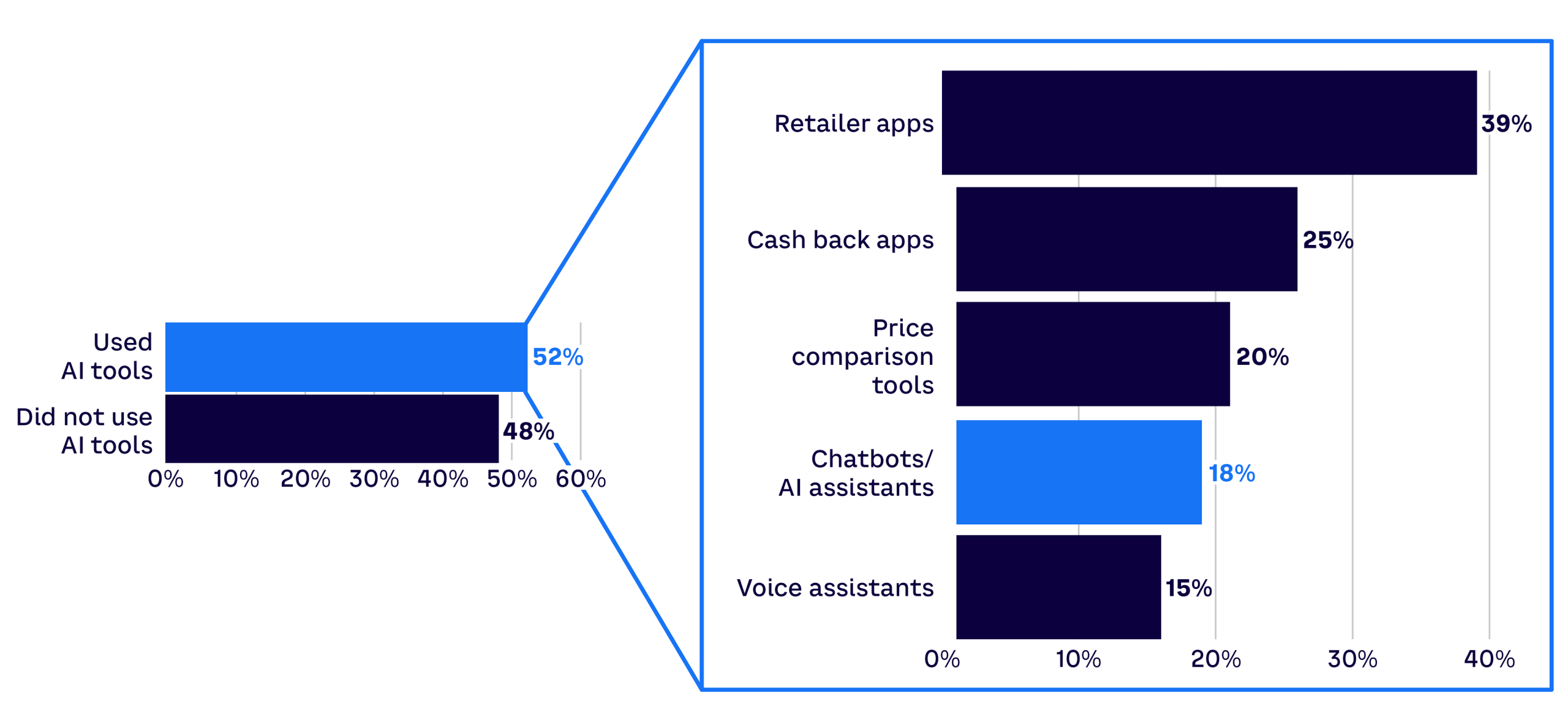
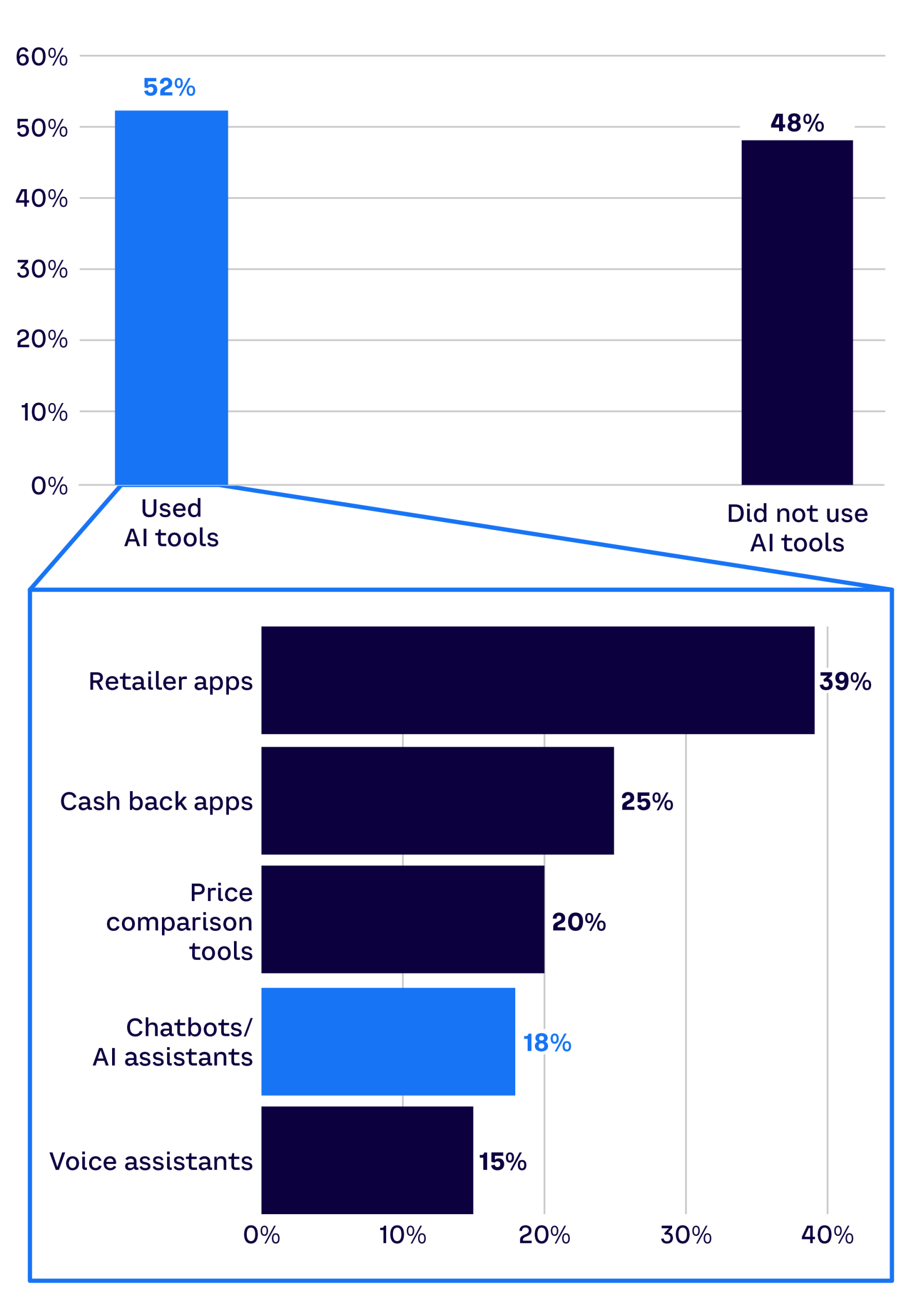
Even physical stores are not immune. Roughly 80% of retail transactions still happen in person, but a growing number of those shoppers walk in with an AI-informed plan already on their phone. Recent data from Acosta Group found that nearly one in 10 shoppers used third-party AI assistants like ChatGPT and Gemini while shopping in-store over the Thanksgiving weekend last year — without any encouragement from the retailer to do so. That rate of proactive adoption, in a channel with no built-in AI prompts or incentives, may be the more telling signal of where behavior is heading.
AI TOOL USAGE IN-STORE, THANKSGIVING 2025
Source: Acosta Group
NOT SEARCH 2.0
It would be tempting to file this alongside earlier waves of digital disruption (e.g., the rise of Google, the explosion of social commerce) and assume the same playbook applies. There are real parallels. Sonata Insights Founder Debra Aho Williamson, a veteran digital media analyst who has spent 17 years tracking social media’s evolution, sees a familiar pattern: “Like search and social before it, AI requires brands to establish an organic presence first,” she says. “In search, it was about having a Web page the engine could actually find. In social, it was having a brand page. Here, it’s the same — you need to show up in AI results before you can think about paying for placement.”
The organic-then-paid sequence is consistent. So is the speed at which performance marketing infrastructure scales once the pipes are laid. “The infrastructure from social and search advertising means performance-marketing capabilities can scale to AI advertising more quickly,” Williamson notes. “And these companies are using AI to build their own products — development will be exponentially faster than anything we saw with search or social.”
But something structurally different is happening beneath those familiar patterns. Search is impersonal: you type a query, scan a results page, and move on. Social is communal: you state your tastes in public and are influenced by friends and creators. AI shopping is neither. It is a private, evolving conversation with an entity that adapts to you (see ADL Viewpoint “Beyond Prompts: Building Business for the Age of Agentic AI”).
Eystein Thanisch, Senior Technologist at ADL Catalyst and coauthor of the Amplify article on AI shopping agents, draws a distinction with earlier technologies. “Software is knowable — it’s deterministic and documented. If I do something, and you do the same thing, we can compare results and understand why they differ,” he says. “With AI, each person carves out an individual experience. You can only really talk about tendencies and norms — there’s always the possibility that something quite different happened in someone else’s conversation.”
The consumer’s relationship with an AI shopping companion is personal in a way no prior digital channel has been. Williamson experienced this firsthand. Searching for a moisturizer alternative, she spent 15 minutes in conversation with ChatGPT, discovered a brand she had never encountered (Paula’s Choice), and switched permanently. “That changes advertising’s role in building awareness and mental availability,” she says. “The entire purchase funnel — awareness, consideration, purchase — is compressed into one environment.”
A 2025 Bloomreach consumer study found that 46.2% of consumers believe an AI shopping assistant offers more honest advice than a friend. Somewhat ironically, as consumers turn to algorithms, they want those algorithms to feel more human. The same study found that 93% of shoppers consider conversational capabilities important. “Even though people have been trained since the birth of e-commerce to search a certain way, it’s clear they’re relishing the opportunity to speak like people again when shopping online,” the study states.
The consumer’s relationship with an AI shopping companion is personal in a way no prior digital channel has been

FROM SINGLE PLAYER TO MULTIPLAYER
Consumer AI began as a solitary experience: a chat thread with one person and one assistant working through a task. Thanisch describes it as “a conversation with a brilliant but erratic being.” It’s private and individualistic, with each user carving out their own relationship.
That is changing. People are already sharing chat threads the way they share articles — forwarding AI research to a spouse, sending a product comparison to siblings coordinating a gift, or citing an AI analysis in a professional meeting. What started as a productivity tool is acquiring social dimensions. “It’s gradually become more communal and collaborative,” Thanisch says. “Originally, it was considered almost naughty to use ChatGPT in a workplace setting. Today, clients explicitly ask us how we’re using AI. They’d be concerned if we weren’t.”
The trajectory indicates something more deliberate. The fashion app Doji launched as a personal AI try-on tool that lets users create a digital likeness, see themselves in real products, and shop their favorites — a narrow, single-player utility. Its March 2026 update shifted the center of gravity. The tool’s new features are built around other people’s looks, remixing styles, following friends and tastemakers, and sharing inspiration. The AI try-on engine didn’t disappear, but it was demoted from a headline feature to a social-experience enabler.
The shift from AI-assisted personal utility to AI-enabled social discovery may preview a broader trend. Williamson sees it as a counter to one of AI’s biggest criticisms: that it isolates people from human relationships. “These simple things — sharing a chat, bringing someone into a decision — are ways for AI to become a more social experience,” she says. Williamson envisions a future in which influencer content integrates with AI shopping research and creators are compensated because the AI can track their influence on purchases. In other words, the solo chat thread may not stay solo for long.
What started as a productivity tool is acquiring social dimensions
WHAT THIS MEANS FOR THE C-SUITE
ADL’s experiments with AI shopping agents found that these systems are “highly averse to influence from ads or promotions,” ignoring sponsored options even when they offered the best deal. That will likely evolve as commercial pressures mount. OpenAI began running ads on ChatGPT in early 2026, though notably outside the conversational results themselves — a concession to user trust that keeps promotional content at arm’s length from the AI’s recommendations. But for now, the competitive advantage belongs to companies with rich, accurate, well-structured product data — not the biggest ad budgets.
For retailers, the shift presents both a challenge and an opportunity. Discovery is moving upstream, away from their own websites and apps, which threatens the advertising revenue that has become a critical margin contributor. But the data that retailers hold about real products and real transactions makes them credible sources in the eyes of AI systems — a role that could become more, not less, valuable if they choose to develop it.
The question for retail marketing executives is where to focus first.
Make Product Data Your Strategic Infrastructure
The single most actionable investment is in the structured data that AI systems use to evaluate and recommend products (see ADL Viewpoint “Managing Data in an AI-Driven World”). This goes beyond traditional e-commerce content. AI shopping agents parse intent-based attributes: contextual details that help match a product to a consumer’s stated need, not just a keyword. A major consumer packaged goods company that sells almost entirely through retailers rather than its own sales channels recently convened its sales teams to compare notes on what its retailer partners are doing to prepare. The picture is uneven: one retailer is actively building a mechanism for brands to feed contextual product information directly into its AI assistant — data that would never appear on a product detail page but enables more informed recommendations. Others have barely begun the conversation. Several have launched on-site AI assistants that perform poorly, having rushed to market before their underlying product data could support a credible experience.
The lesson from early movers is that the quality of your product catalog is the foundation on which everything else depends. Rather than waiting to be asked, brands should be approaching their retail partners with enriched content and structured attributes that support AI-driven discovery. For retailers, the priority is ensuring their product data infrastructure is crawlable and well-organized because an AI system that can’t access your catalog will simply recommend from one it can.
Accept That Your Analytics Dashboards Are Now Incomplete
Referral traffic from AI platforms is trackable; firms like Sensor Tower have documented their steady growth across major US retailers. But the larger shift is invisible. Consumers who research with AI and then navigate directly to a retailer’s website or app leave no trace of the AI’s influence. Retail analyst Nikki Baird, VP of retail innovation at Aptos, describes this as “dark intent.” Recently, she used ChatGPT to evaluate alternatives to her regular pet food brand, decided to switch, then visited a retailer where none of her AI-informed reasoning was visible. The retailer saw a search and a purchase. It had no idea what actually drove the decision or that a brand defection was underway.
This is the dark search challenge at its most concrete. Executives must assume their current measurement tools are capturing a fraction of AI’s influence on purchase decisions and plan accordingly. That means investing in new attribution research, commissioning qualitative studies of how consumers are using AI in their purchase journeys, and resisting the temptation to dismiss AI-referred traffic as a rounding error because the referral numbers remain small (see ADL Viewpoint “Navigating AI: Challenging the North Star”).
Prepare for Retail Media’s Next Chapter
The current retail media model (dominated by on-site sponsored product ads) was built for a browsing era in which consumers click through search results, explore category pages, and generate intent signals at every step. The AI-compressed purchase journey produces far fewer signals. A shopper arriving on a single-SKU mission from an AI recommendation is not browsing, not comparing, and not seeing ads. That is a structural challenge for retail media businesses built primarily on on-site inventory.
That’s not the end of the story. Early signals suggest new models are being created and piloted. Target’s advertising business, Roundel, is actively promoting a collaborative bidding model with brand partners inside ChatGPT — a format where the retailer and brand jointly invest in placement within the AI environment. Others are exploring post-purchase engagement as a way to recapture value after the initial transaction: programmatic product sampling, cross-sell offers, and incentives to return.
Ian Simpson, SVP of Innovation and Strategy at Sensor Tower, advises brand leaders to “hold on for dear life.” Brands are watching simultaneous growth in a channel no one fully controls while continuing to run after every legacy marketing channel that demands budget and attention. The executives who move first on product data, measurement honesty, and media model experimentation will not have all the answers — but they will have a meaningful head start on those who wait for the landscape to settle.
The executives who move first ... will not have all the answers — but they will have a meaningful head start

WHAT COMES NEXT
My Shark Glossi purchase was a solo affair: me, my AI assistant, 15 minutes — done. But imagine a version in which my hairdresser’s recommendation feeds into the conversation; a girlfriend joins the chat to compare notes; and reviews come with context from people with hair like mine. The technology to enable all of this either exists today or is rapidly being built — and early signals suggest the shift toward more shared, collaborative AI experiences has already begun.
Whether AI shopping remains a private, solitary habit or evolves into something richer and more shared may ultimately determine how influence is shaped in the next era of retail.
For retailers and brands, the immediate challenge is building the capabilities to compete in a world where discovery happens outside your control. This means making product data a core capability, rethinking how you measure what drives purchases when AI influence isn’t visible in your data, and testing emerging media and partnership models within AI environments. Targeted experimentation, supported by the right analytical and strategic capabilities, will be key to building advantage in this evolving landscape.
The solo chat thread is where this began, but it is unlikely to be where it ends.
Key takeaways
- AI is creating a shadow shopping economy in which consumer purchase decisions form inside private AI conversations before even visiting a retailer’s site.
- GenAI referral traffic to major US retailers is growing every month, with Best Buy reaching 1.29% of all visits in January 2026.
- AI shopping compresses the top and middle of the purchase funnel into an intimate conversation with an assistant that adapts to you.
- AI shopping may evolve from a solitary activity into a social one — shared chat threads, influencer integration, and co-shopping tools are early signals.
- Competitive advantage belongs to brands with rich, structured product data and authentic reviews, not the biggest ad budgets.