
13 minute read
Jul 2026

Automate to Aviate




Airport labor shortages and ramp-safety risks are moving autonomy from trials to live operation. But the bigger story may be strategic: automation could change how ground handling is staffed, governed, financed, and delivered.
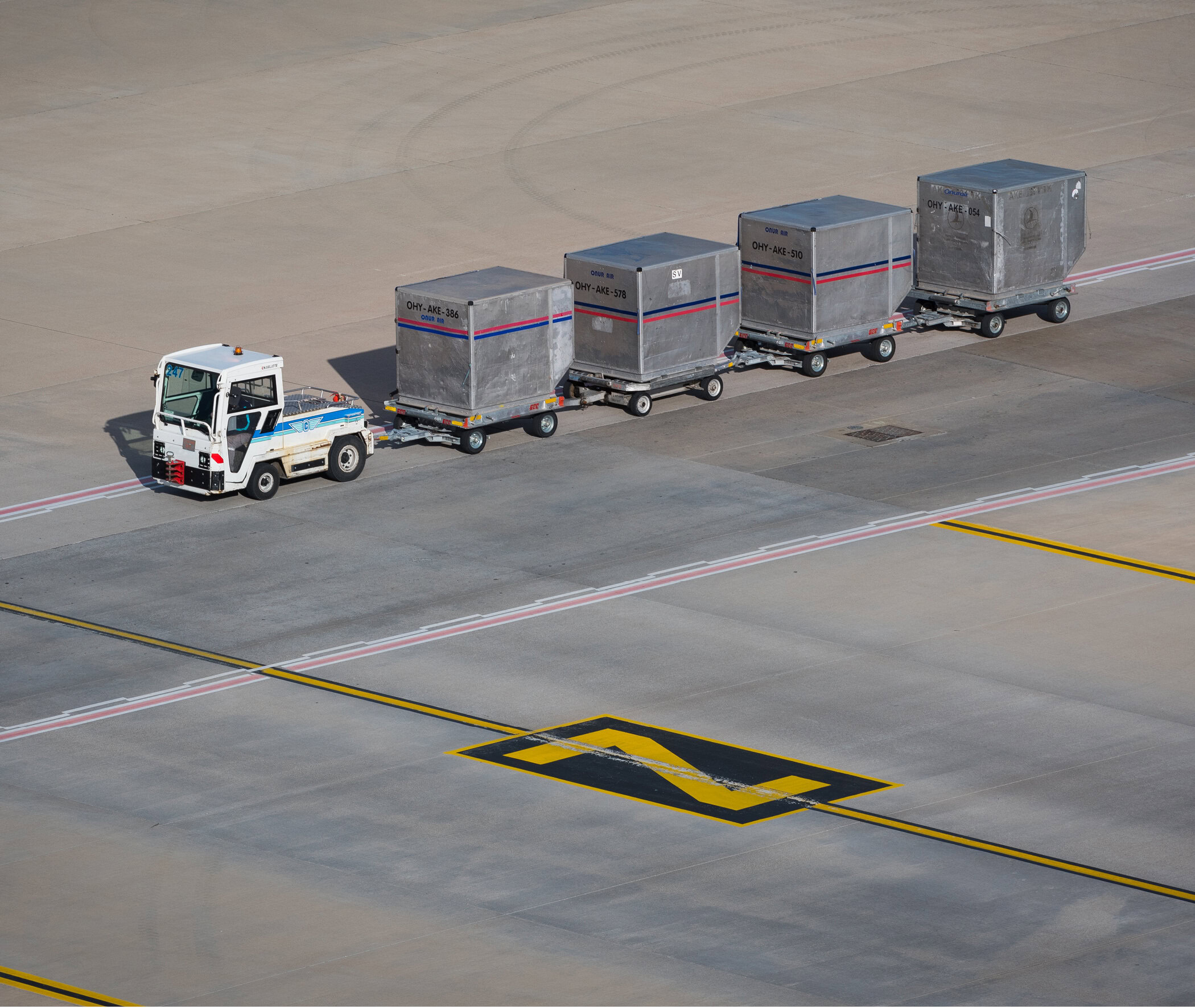
It’s a scene frequent flyers often see from their airplane window seats: a tow truck driver parks a train of luggage wagons beside the aircraft. A team of baggage handlers offloads their contents, moving everything from suitcases to musical instruments to skiing gear onto a motorized belt loader that propels them into the aircraft hold.
That familiar, human-populated scene could be set for considerable change in the next few years. This ordinary task has the right elements to make it ripe for technological disruption, according to Alessandro Rosati, Principal with Arthur D. Little’s (ADL’s) Travel, Transportation & Hospitality (TTH) practice.
Thanks to industry-wide difficulties in hiring ground-handling crew, Rosati says, the tow trucks circling those wagons (known as “dollies” in airside argot) could become self-driving vehicles. Later, after the technology matures, robots could make their ways to the runway to unload and load baggage.
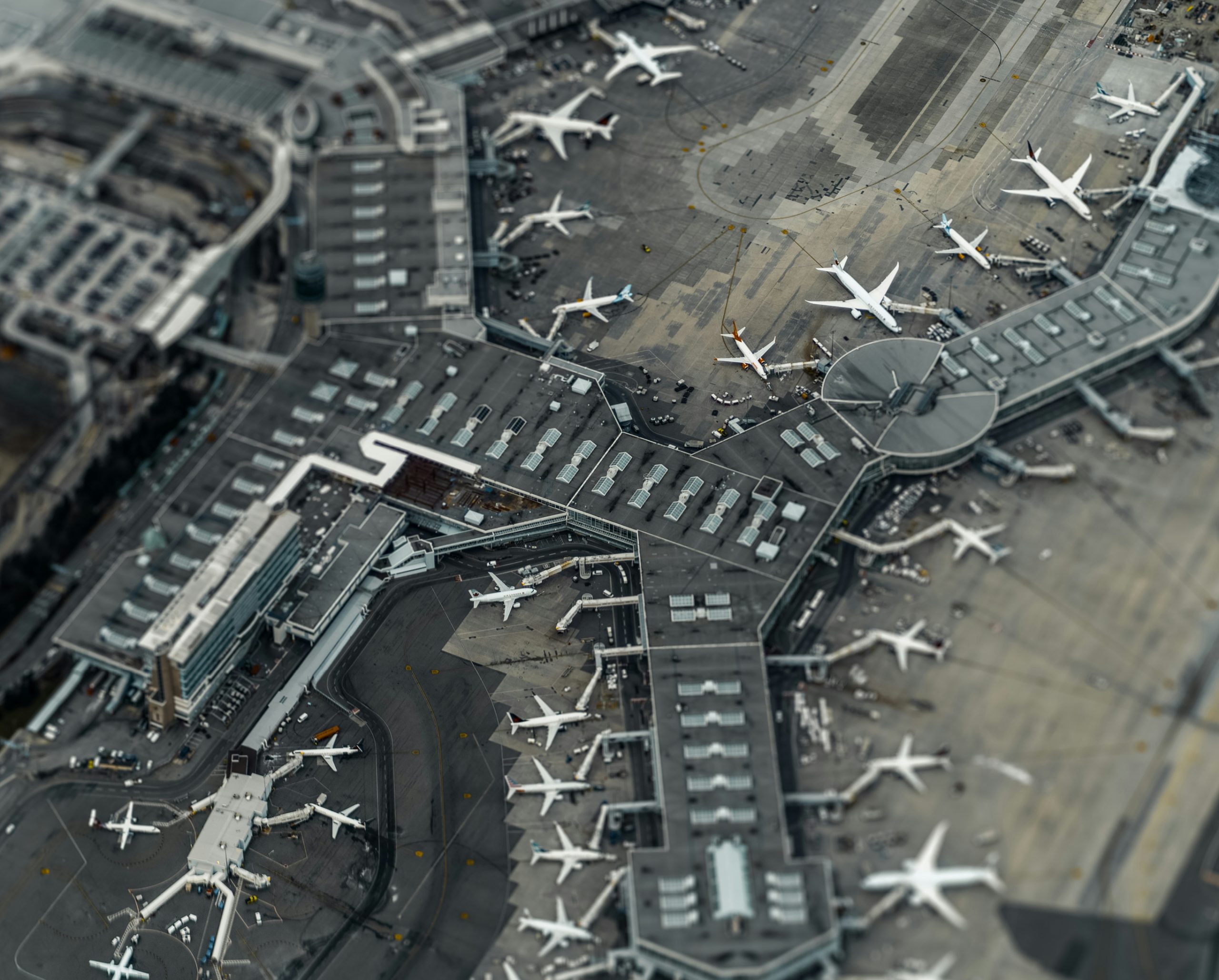
This type of automation, if it works reliably, could spread widely across the airport industry over the next five to 10 years. Ground support equipment (GSE) providers and airside service operators will be in the vanguard of adopting automated, robotic, and self-driving technologies in baggage and cargo handling. The more mature applications are already being trialed at some major airports, with some moving to deployment, says Rosati.
A raft of airport automation applications will likely follow as technologies mature, he says, including security-screening robots, terminal-cleaning droids, perimeter-inspection drones, driverless pushback tractors for aircraft, and even self-driving passenger buses. Rosati asserts that these systems will “cut costs, help operators cope with labor shortages, increase safety levels across airside operations, and boost on-time departures.”
That should allow operators to provide more consistent service because automated systems can help reduce variability in repetitive tasks and support operations when staffing is constrained, says Mathieu Blondel, Partner with ADL’s TTH practice and Global Head of its Aviation Competence Center.
This is not to say ousting humans is the overarching aim. “Automation will first take over selected, repetitive tasks that are hard to hire for in areas like baggage handling, but people will remain vital for supervision and handling edge cases, exceptions, and irregular operations,” says Rosati.
Structurally, however, Blondel expects adoption of airside and terminal automation to generate profound business impacts. The strategic question is not which robots work, but who can fund, operate, maintain, and govern them at scale.
Why Airports Are Turning to Automation Now
A mix of factors is driving the airport industry toward this machine-oriented future, led by two societal ones in particular, says Blondel.
“The first shift started during the COVID lockdowns in 2020, when major airports like Amsterdam and Frankfurt asked their subcontractors and ecosystem partners to downsize. But when the air traffic came back, they could not find enough people to reemploy, and since then, they have had a lot of difficulty attracting people to the poorly paid, sometimes physically demanding jobs that are critical to aviation — such as moving baggage in and out of aircraft and passenger security-screening in the terminal.”
The second shift Blondel cites is demographic: aging populations and falling birth rates are shrinking the working-age population in Europe, Japan, China, and Singapore. The Organisation for Economic Co-operation and Development (OECD) warns that by 2060, it could decline by more than 30% in a quarter of its member countries.
Safety is another driver. In 2024, the International Air Transport Association (IATA) found that 40% of ground damage to aircraft fuselages was caused by collisions with human-controlled airside equipment, including dollies, tugs, cargo loaders, passenger stairs, belt loaders, and boarding bridges. “The introduction of automation could diminish this,” says Rosati.
The human cost is high, too. Rosati notes that in 2024, the US government’s Bureau of Labor Statistics found that ground operations at airports suffer a level of occupational injuries twice as high as the average in other similar freight-moving industries, such as trucking and warehousing.
“This is not only due to accidents, but to the activity itself: carrying very heavy bags causes many back injuries, for instance,” says Rosati.
Automation will first take over selected, repetitive tasks that are hard to hire for in areas like baggage handling, but people will remain vital for supervision and handling edge cases, exceptions, and irregular operations
First Wave: Driverless Tugs, Autonomous Dollies & the Vendor Race
With high labor costs, aging populations, and safety issues on one side, and robotics technologies getting more mature and efficient on the other, there is a clear case for airside automation, says Blondel. It’s no surprise that major airport hubs in Singapore, the Netherlands, and Switzerland have been among those trialing enabling technologies from autonomous systems vendors.
“Over the last five years, there have been multiple trials across airports globally, where they have been testing fully automated baggage transport dollies,” says Rosati. The earliest experiments started with retrofits of existing machines, but more recent pilots involved dedicated autonomous systems.
Why begin with airside baggage delivery and ramp loading? Simple, says Rosati: the tug driver and some of the most repetitive baggage-handling tasks are among the functions that can most easily be considered for automation.
To automate these functions, the tractor that tows baggage dollies (or the trolleys containing cargo bins shaped for in-fuselage stowage) can be made driverless, allowing it to pull dollies that used to work with human-driven diesel or electric tractors.
Several vendors are trialing and, in some cases, deploying advanced driverless airside systems in the automated dolly and cargo tug space. They include Aurrigo (UK), AeroVect (US), and TractEasy, a France-based joint venture marrying the GSE tractor kit of TLD with the driverless technology of autonomous passenger shuttle maker EasyMile.
Aurrigo is fielding its technology in trials at Zurich International Airport and Singapore Changi Airport; AeroVect is doing likewise at Dubai International and San Francisco International. TractEasy is deployed at Istanbul and Frankfurt airports and is in advanced Level 4 driverless tug trials with Japan Airlines (JAL) at Tokyo’s Narita International Airport.
That supplier push is being reinforced by operators struggling to keep critical ramp roles staffed. Avports, an airport services provider that runs airside services at 15 US airports, including LAX and Detroit, offers one such demand signal.
“Post-COVID, the ground-handling world lost a huge chunk of its workforce, and it has not fully recovered,” says Avports COO Arturo Garcia-Alonso. “Autonomous GSE is not about eliminating jobs; it is about filling positions no one is applying for.”
Garcia-Alonso also sees the safety logic behind the vendor push. “Human error is still the leading cause of ramp damage, and the numbers are significant,” he says. “The value of sensor-equipped automation is that it can help support more consistent performance in the kind of long-shift, all-weather conditions that make ramp work so demanding.”
That does not make automation a replacement for every worker, of course. At Avports, powered wearable exoskeletons are assisting ramp agents with heavy lifting, underscoring the likely mix of automation, augmentation, and human supervision.
Second Wave: Robots in the Aircraft Hold
JAL has been vocal in proposing how the next phase of this automated airside plan might unfold: getting baggage off dollies and into the aircraft hold using robots, not people.
In April 2025, JAL videos attracted attention online when airport executives revealed they would experiment with a sci-fi-like solution: Chinese-made humanoid robots from Unitree and UBTECH that would learn to place baggage and unit load devices in aircraft holds in tests at Tokyo’s Haneda Airport, running from May 2025 until 2028. The aim is to see whether humanoids can address JAL’s 20% staff shortage on the ramp.
JAL’s bipedal droids may look like the stuff of a science-fiction movie, but Blondel says that despite the sometimes-high degree of human remote control in their operation at the moment, the industry should not be too dismissive of what looks like sci-fi becoming reality.
“It is still very early stages with these humanoids, and sure, they are not yet as capable as humans in many real-world tasks, but everything is improving very quickly in that domain,” Blondel says. In China, he notes, many humanoids struggled or failed to finish Beijing’s 2025 half marathon, while at the 2026 event, the winning autonomous humanoid completed the course faster than any human runner.
“So, in just one year, they had this huge improvement. When you think about a closed environment like an airport, it could mean capabilities can increase rapidly,” he says.
Blondel concedes, however, that a wheeled robot with arms for picking up baggage from dollies and placing them on a belt loader would be, on a flat airport apron, a much more stable option than a legged robot. Such wheeled form factors are much more likely to be deployed at scale before any of JAL’s humanoids are ready for primetime.
With high labor costs, aging populations, and safety issues on one side, and robotics technologies getting more mature and efficient on the other, there is a clear case for airside automation
Case Study: Changi’s Maximum Automation Bet
If JAL’s plans sound ambitious, consider Singapore Changi, which is building a fifth terminal to increase the airport’s passenger capacity by at least 50% — adding capacity for 50 million more passenger movements and bringing the total to 140 million passenger movements per year.
So far, so ambitious. But get this, says Blondel: “Changi does not want to add a single job on the ground to achieve this. It means they need to be super productive or automate. And they have chosen maximum automation.”
On its website, Changi confirms this, saying that when T5 opens in the mid-2030s, it will let the airport run with “reduced reliance on manpower” and that its “baggage robots will be tested for operation under rain and lightning conditions at the aircraft stands, to enable continuous operations” in the equatorial island’s notorious downpours and storms.
Barriers to Rollout
Despite Changi’s bullish automation thrust, the robotic technologies (beyond the driverless tugs already moving into deployment) are immature. “Adoption of automation will be uneven and constrained,” says Rosati. “High-repeatability tasks will move first; mixed-traffic, underwing work will take longer.”
As autonomous equipment becomes more connected and operationally critical, resilience becomes as important as productivity.
Continuous operations will also require cybersecurity of the highest order as airports move to networks of robots and autonomous systems on the apron and in the terminal, with some machines crossing taxiways and runways. No one in this automated nirvana will want to be in charge of a population of airport robots whose software has been locked up by ransomware.
At a time when cyberattacks on aviation systems increased 600% in a single year, from 2024–2025, how should these emerging automated airports pull up the drawbridge and defend themselves?
“Preparedness starts with knowing which systems and processes are critical, how they depend on one another, and where the single points of failure are,” says Tom Teixeira, Partner in ADL’s Performance practice. “Organizations then need to test realistic cyberattack scenarios against those risks.”
Teixeira says aviation’s CISOs must put senior management under pressure to make effective decisions when deficiencies are detected, so they are addressed in technology upgrades and improved business continuity planning.
AI adds another layer of risk: models and the physical systems they power, including robots, can be attacked in new ways. That concern prompted the US Federal Aviation Administration’s (FAA’s) Airport Cooperative Research Program (ACRP) to hold a May 2025 workshop on AI’s benefits and risks for airports.
Strategic Implications: From Automation Projects to Operating Model Decisions
Airside automation is not one technology story but a sequence. Driverless baggage tugs and autonomous dollies will likely scale first because they address repeatable, high-pain-point tasks. More complex underwing work, including robotic baggage loading inside aircraft holds, will take longer because it requires tighter integration with people, aircraft, weather conditions, safety rules, and irregular operations.
That means aviation executives should treat automation as an operating model redesign, not a procurement exercise. Airports, ground handlers, and GSE providers need to decide not only which technologies to deploy but also how those technologies will be supervised, maintained, integrated into daily operations, governed for safety, protected from cyber risk, and supported by the workforce.
For ground handlers, the key question is scale. Operators that can standardize processes across stations, train supervisors, and integrate autonomous equipment into irregular operations will be better positioned than those that treat robots as isolated assets. The winners will be those that can turn automation from a pilot project into a repeatable operating capability.
That operating shift also has an economic consequence. As automation moves from trials to deployment, parts of ground handling begin to shift away from a purely labor-intensive OPEX model and toward a more capital-intensive model requiring up-front investment in equipment, software, integration, maintenance, and lifecycle support. Blondel notes that this could favor larger players with stronger balance sheets and potentially accelerate consolidation because they can fund equipment, absorb implementation risk, and use lower unit costs to win market share.
For OEMs and technology vendors, that CAPEX burden creates an opportunity to rethink the commercial model. Instead of relying only on one-off equipment sales, vendors may increasingly offer leasing, maintenance, software support, upgrades, and uptime guarantees. Managed service models could make automation more attractive to customers who want the productivity benefits without carrying the full up-front investment themselves.
Airports will also need to pay close attention. If automation makes ground handling look more like infrastructure — capital-heavy, standardized, safety-critical, and tightly integrated with airport operations — some airport operators may see a case for taking a more active role in the ecosystem, whether through partnerships, operating standards, shared platforms, or, in some cases, direct participation.
From a strategy standpoint, this is about more than robots cutting costs. Automation could redraw parts of the airside value chain. The likely winners will be those that connect technology deployment to workforce strategy, safety performance, cybersecurity resilience, operational standardization, and a clear economic model.
Preparedness starts with knowing which systems and processes are critical, how they depend on one another, and where the single points of failure are
Key Takeaways
- Airport automation is being driven by labor shortages, demographic constraints, ramp-safety risks, and the need for more reliable service.
- The near-term opportunity is in repeatable use cases such as driverless baggage tugs and autonomous dollies.
- The technologies that scale first will be those that solve staffing, safety, and reliability problems in day-to-day operations.
- Cybersecurity, safety governance, and human supervision must be designed into autonomous airside systems from the outset.
- Strategically, automation should be treated as an operating model redesign, not a one-off equipment purchase.
- Over time, CAPEX-heavy automation could favor scaled ground handlers, create OEM leasing or managed service models, and give airports reasons to take a more active role in the ground-handling ecosystem.