
12 minute read
Nov 2026

Built for Speed



It’s hard to overstate the impact the Chinese automotive industry is having on the global market, even in places where Chinese vehicles are effectively banned from import. Expectations for accelerated development are upending corporate structures and management techniques worldwide as companies try to cut new-vehicle timelines from the historic four to six years to 24 months or less.
This obsession with “China Speed” isn’t just a case of boardroom FOMO (fear of missing out). China’s auto industry has exploded, growing by nearly 50% in the past decade to roughly twice the size of the US market. It’s also leading the world in electric mobility readiness, as highlighted in Arthur D. Little’s (ADL’s) latest GEMRIX report.
But China Speed is about more than working faster. It reflects a fundamentally different operating model: shorter product cycles, fewer organizational layers, closer integration between engineering and manufacturing, simpler supplier networks, and quicker iteration.
Still, we must ask how much of that organizational agility can translate to established manufacturers operating in very different markets and institutional environments. Can legacy automakers really match China’s speed without simply importing a very different operating model? They can, according to our experts — but only if they focus less on imitation and more on identifying the structural sources of delay within their own organizations.

Embrace Architectural Agility, Not Workforce Power
There’s a common belief that a fundamental driving force behind China Speed is brute force: more workers clocking more hours to get more done. (Although the culture of mandating that workers clock in from 9 am to 9 pm six days a week is officially illegal, it’s still an expectation many manufacturers are leaning into.)
However, according to Niklas Brundin, Partner with ADL’s Automotive & Manufactured Goods (AMG) practice, it isn’t the key advantage at play. “It would be a misconception to think of it only as the Chinese working hard,” he says. “That’s just part of it; they have built the whole system to move fast.”
In practice, that means fewer layers, simpler supplier networks, more integrated engineering, and shorter paths between information and action.
Brundin sees the bigger advantage in having fewer legacy systems, procedures, and entrenched supplier relationships. “Working very long hours — we cannot import that into Europe and the US,” he says. “And we shouldn’t get too caught up in that. It’s the efficiency of the system we need to learn from.”
Philipp Seidel, Principal with ADL’s AMG practice, points to fragmentation as a key source of delay. “One of the major bottlenecks contributing to longer development timelines at Western manufacturers is their fragmented ecosystem. The development process involves many suppliers across different tiers: not only hands-on work, but also brain work.”
The implication for established manufacturers is to tackle complexity both inside the organization and across the supplier ecosystem. “There is more of a vertically integrated supply chain in the Chinese industry. They also have fewer layers and levels, so the organization seems to be less complex,” says Seidel.
"One of the major bottlenecks contributing to longer development timelines at Western manufacturers is their fragmented ecosystem"
Get Lean, Get Smart
The transformation into leaner, more agile automotive organizations is aided by a new generation of vehicles. Many of the world’s most popular cars today feature software-defined behavior and, in many cases, simplified componentry.
“It’s still high-tech batteries, inverters, electric motors, all the software components, but there’s less mechanical complexity,” says Seidel. “I think the Chinese companies, especially, have the processes and the experience to integrate all these components much quicker.”
Once again, much of that comes from stronger vertical integration. According to Brundin, working with fewer suppliers can accelerate schedules. “Chinese companies tend to have fewer suppliers, giving each one a little more scope while setting high expectations for fast iteration,” he says. “That’s part of the recipe.”
China’s advantage is visible not just in how quickly vehicles are developed, but in how rapidly its broader EV ecosystem has scaled. According to ADL’s 2026 GEMRIX report, China had about 20.7 million charging points by early 2026 — vastly more than the other major automotive markets shown below.
Simpler supplier networks and fewer organizational interfaces can dramatically accelerate execution
Public charging points, early 2026
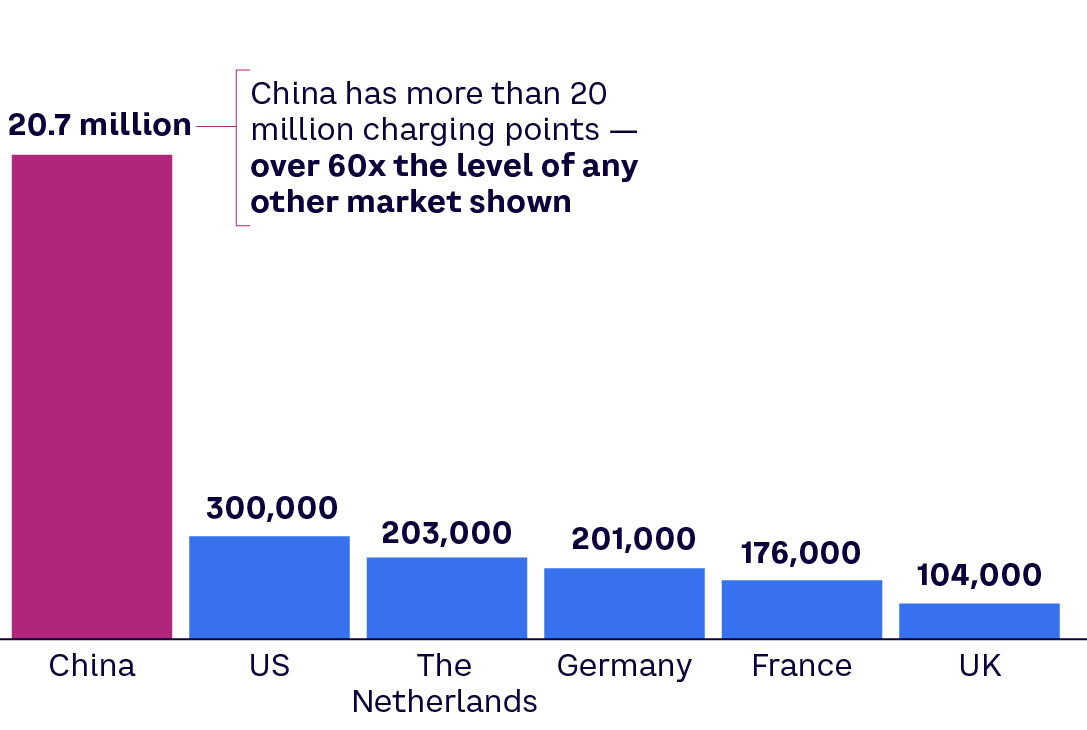
Source: Arthur D. Little
Vertical integration extends to software, where Chinese businesses can typically do more in-house, reducing the need for external expertise. Accordingly, General Motors (GM) is taking cues from software-minded methodologies, like continuous integration, and applying them to hardware engineering, says Jason Fischer, GM’s Executive Director of Virtual Integration Engineering.
“We’re using concurrent engineering so we can get data and insights when they matter, instead of doing studies and then sequential engineering, where the data comes weeks to months after the point where you need to make a decision,” he adds.
Fischer says he and his teams are hunting for the tallest poles in the development process and working to whittle them down to size. That means continuously assessing feasibility across the project to identify and address potential bottlenecks early.
“When I make a decision as an executive chief engineer, I want manufacturing. I want purchasing. I want finance. I want program management. I want product engineering. I want design engineering. I want creative engineering,” Fischer explains. “All those insights need to be at my fingertips.”
Increasingly, AI helps teams accelerate the work that informs those decisions. AI tools can dramatically compress development cycles, from basic software integration testing to computational fluid dynamics.
Previously, the vehicle design process moved from a 2D sketch to a 3D rendering before being sent for early aerodynamic testing, a process that could take months, says Fischer. “We can do that in less than a minute now.”
Avoid Technical Pitfalls & Cultural Roadblocks
Of course, AI tools are hardly a panacea, and risks abound. Fischer likens throwing AI at everything to “fishing with dynamite” — launching agentic projects in search of efficiencies while knowing timelines and costs could blow up.
He says being brutally analytical about ROI is key to avoiding wasted effort. “Is this really going to produce something 18 months from now, or two years from now, or three years from now?” he says. If not, kill the project and move on.
Simulated vehicle testing is one area where schedules can be hugely accelerated. However, risk comes into play when the digital doesn’t meet the physical.
“In China, there is an initiative to do more real-world testing to improve the quality of the vehicle,” Seidel notes. “There have been so many issues, and in the end, there is now a government initiative to enforce testing and quality assurance.”
Surprise audits and inspections at Chinese facilities are part of a broader push to improve quality. Regulations such as GB 38031-2025 also mandate more stringent battery testing. Together, these measures reflect a greater focus on quality assurance (QA), an area where many established manufacturers have deep capabilities and experience.
That experience highlights an important distinction: China Speed does not mean Chinese manufacturers lead on every dimension of automotive performance. Faster development and iteration can create advantages in cost, technology adoption, and responsiveness, but other established manufacturers retain strengths in areas such as validation, QA, and engineering rigor. The opportunity is therefore not to declare one model superior, but to understand where different operating models perform best.
Fischer says simulation in this area isn’t necessarily bad. Done right, tools that enable virtual testing and digital validation can deliver a higher-quality product sooner, letting the team focus on the finer points of development. “We can focus on perfecting the vehicle, not on looking for problems that could crop up later on in the development cycle,” says Fischer.
According to Seidel, many organizations fall down in implementing those tools. “These organizations are huge, with dozens of units, departments, and layers,” he says. “Cultural change is never easy, but concentrating decisions at the top or with decision boards can lead to a lack of accountability and sluggish response times.”
Fischer says adopting a startup-like mindset has been transformative at GM. “Over the last couple of years, we’ve had the psychological safety to fail fast, fail early, fail often, and fail our way to success.”
“In China, there is an initiative to do more real-world testing to improve the quality of the vehicle”
Learn, Don’t Copy
Industry experts agree that we need faster timelines. “Change is urgently required,” Seidel says. “This is not about cutting costs by 20% — it’s a shift to a new mindset and culture.” That means a willingness to learn, even if it means working with those you’re trying to beat. “Open up to partnerships, open up to being a scholar again,” suggests Seidel.
It goes without saying that it’s vital to be selective as you explore new models. “Intelligently choose the practices that might actually work in a Western environment, and think realistically about how you can differentiate,” says Brundin.
Speaking at the 2026 Automotive News Congress, Ford CEO Jim Farley gave a prime example of learning rather than copying. A group of Ford engineers was tasked with coming up with possible solutions after research showed Ford’s CATL batteries cost 20% more than those used by China’s BYD in its EVs.
“Our team looked at that 20% and said, ‘Why don’t we benchmark their gearboxes and rotors and motors?’” Farley said. “We found that they were 20% less efficient because the batteries were so cheap. They didn’t need to make a breakthrough in efficiency of the electromagnetic powertrain.”
Farley said his team focused on boosting the efficiency of the rest of the powertrain in the company’s upcoming Universal Electric Vehicle platform. “Now we use 20% less battery than BYD does,” Farley said. “So our cost is about the same.”
The lesson is not to copy a competitor’s advantage, but to understand it — and then find a different way to compete. The same principle cuts both ways: Chinese manufacturers continue to learn from global competitors, just as established manufacturers learn from China’s advances in speed and integration. That means being honest about what sets your product apart and leaning into it. “There are many opportunities there,” Brundin says. “Find your playground.”
“This is not about cutting costs by 20% — it’s a shift to a new mindset and culture.”
The Real Lesson of China Speed
For CEOs outside the automotive industry, the lesson from China Speed is not that every product must be developed in 24 months or that Chinese organizational models should be replicated wholesale. The more useful benchmark is how quickly an organization can learn, decide, and act.
That starts with identifying where time actually disappears. How many layers separate information from a decision? How many suppliers, functions, committees, and approval gates must participate before a team can act? Which activities genuinely protect quality, safety, and the customer — and which persist primarily because that is how the organization has always worked?
The examples from automotive suggest several principles that travel well beyond the sector. Bring functions together earlier rather than passing work sequentially between them. Put the information needed to make decisions closer to the people making them. Use simulation, AI, and other digital tools where they compress feedback loops rather than simply adding another layer of technology. Look beyond the organization itself, too: fragmentation across suppliers and partners can be as great a source of delay as bureaucracy within the enterprise.
But speed needs boundaries. The Chinese experience also demonstrates the potential cost of moving faster than testing and quality systems can accommodate. The objective should therefore not be maximum speed everywhere. It should be deliberate speed: accelerating learning and decision-making while preserving safeguards around quality, safety, workforce sustainability, and capital discipline.
Perhaps the most useful question for a CEO is not “How do we become as fast as China?” but rather “What in our organization makes us slower than we need to be?”
Answering that question may reveal that the biggest constraint is not technology, talent, or even investment. It’s the architecture of the organization itself.
Speed should not come at the expense of quality, safety, workforce sustainability, or capital discipline
Key Takeaways
- Speed is a system, not a staffing strategy. Don’t throw more people or working hours at structural sources of delay. Look instead at layers, handoffs, fragmented responsibilities, and slow decisions.
- Shorten the learning loop. Bring functions together earlier, ensure decision makers have the information they need, and use AI, simulation, and other tools to accelerate feedback and learning.
- Reduce fragmentation. Vertical integration isn’t always the answer, but simpler supplier networks and fewer organizational interfaces can dramatically accelerate execution.
- Know where not to accelerate. Speed should not come at the expense of quality, safety, workforce sustainability, or capital discipline.
- Learn, don’t copy. Benchmark what makes faster competitors successful, then determine which practices fit your organization and where your own sources of differentiation lie.