


12 minute read
Mar 2026

CTRO Shift


When the written history of the early 21st-century economy comes about, the term “transformation” rather than “change” will best capture the turbulence of our times (although “powered by AI” will surely run a close second).
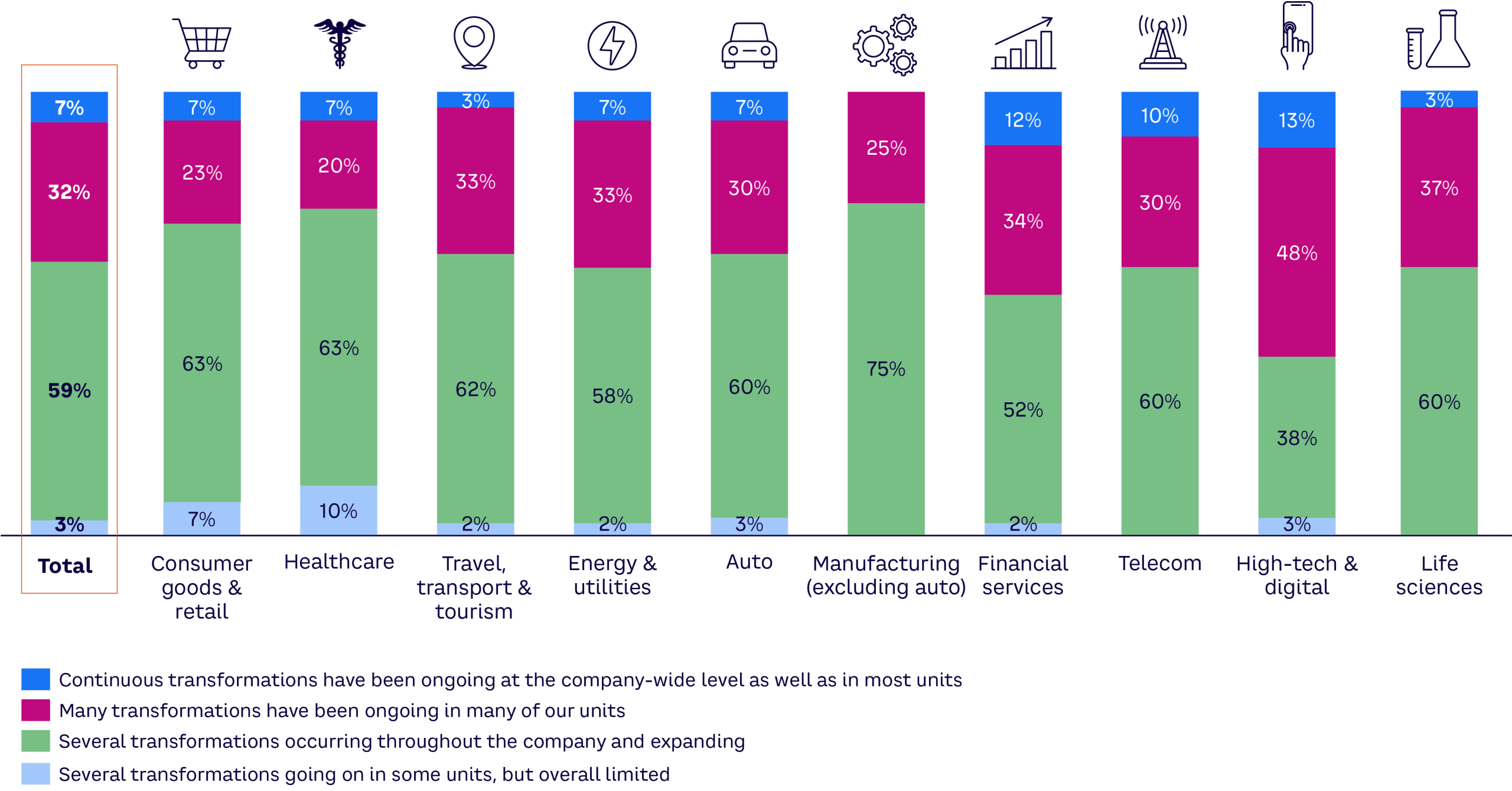
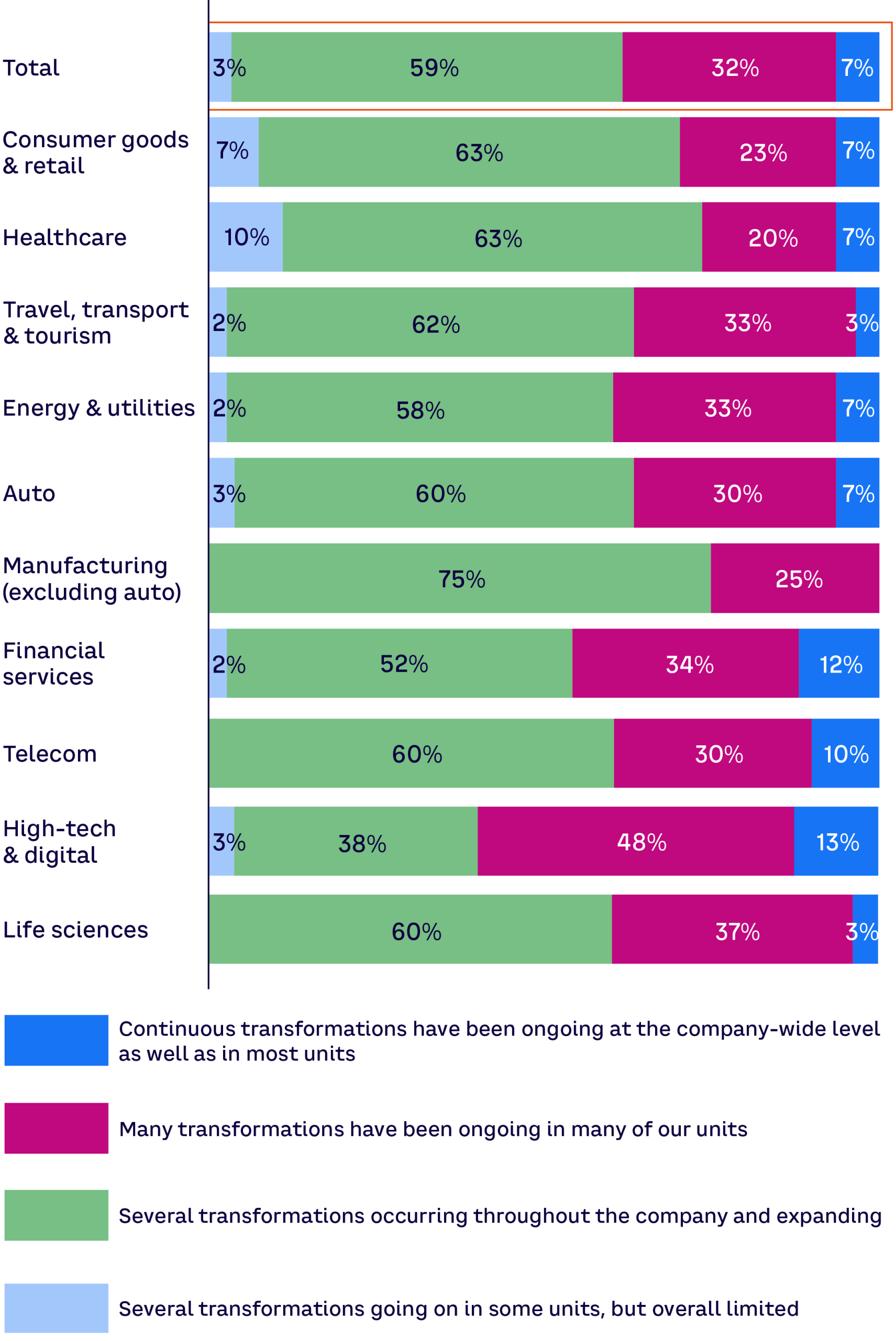
Extent of transformation by industry
Source: Arthur D. Little
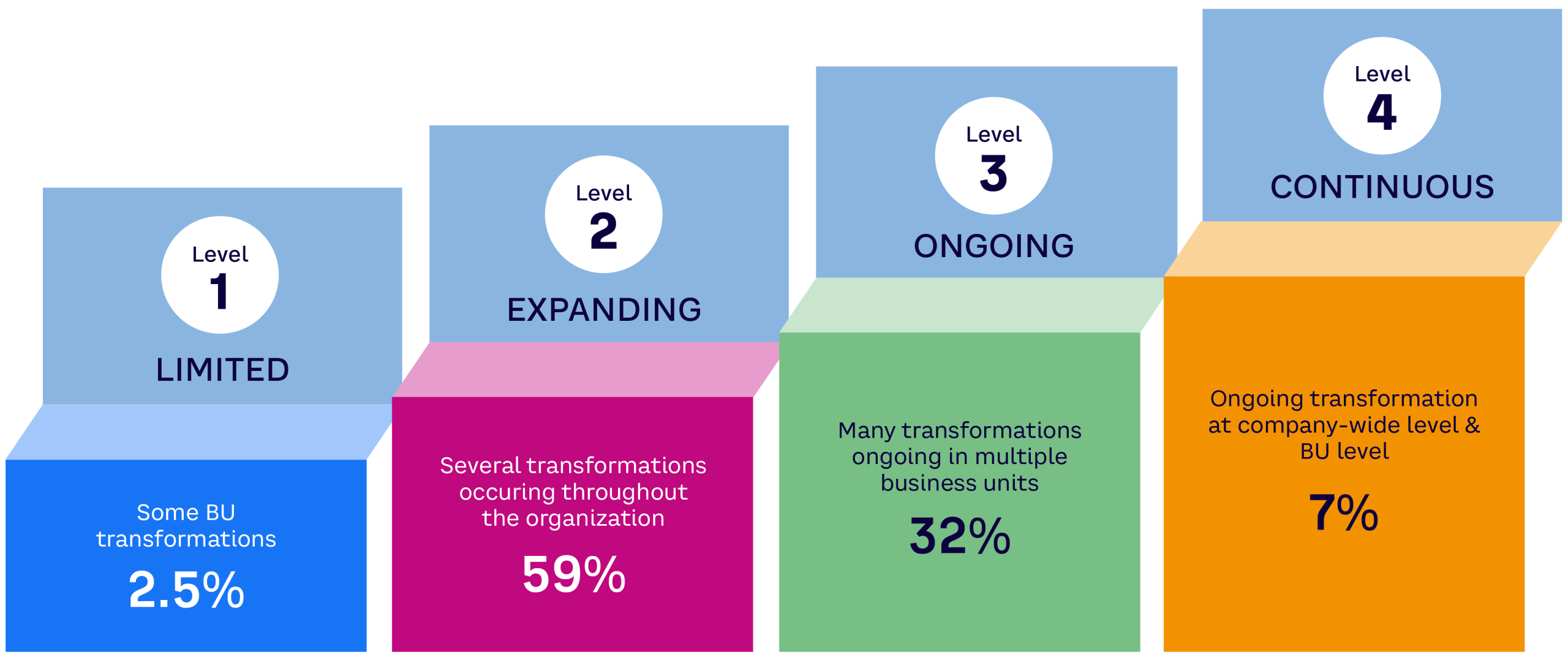
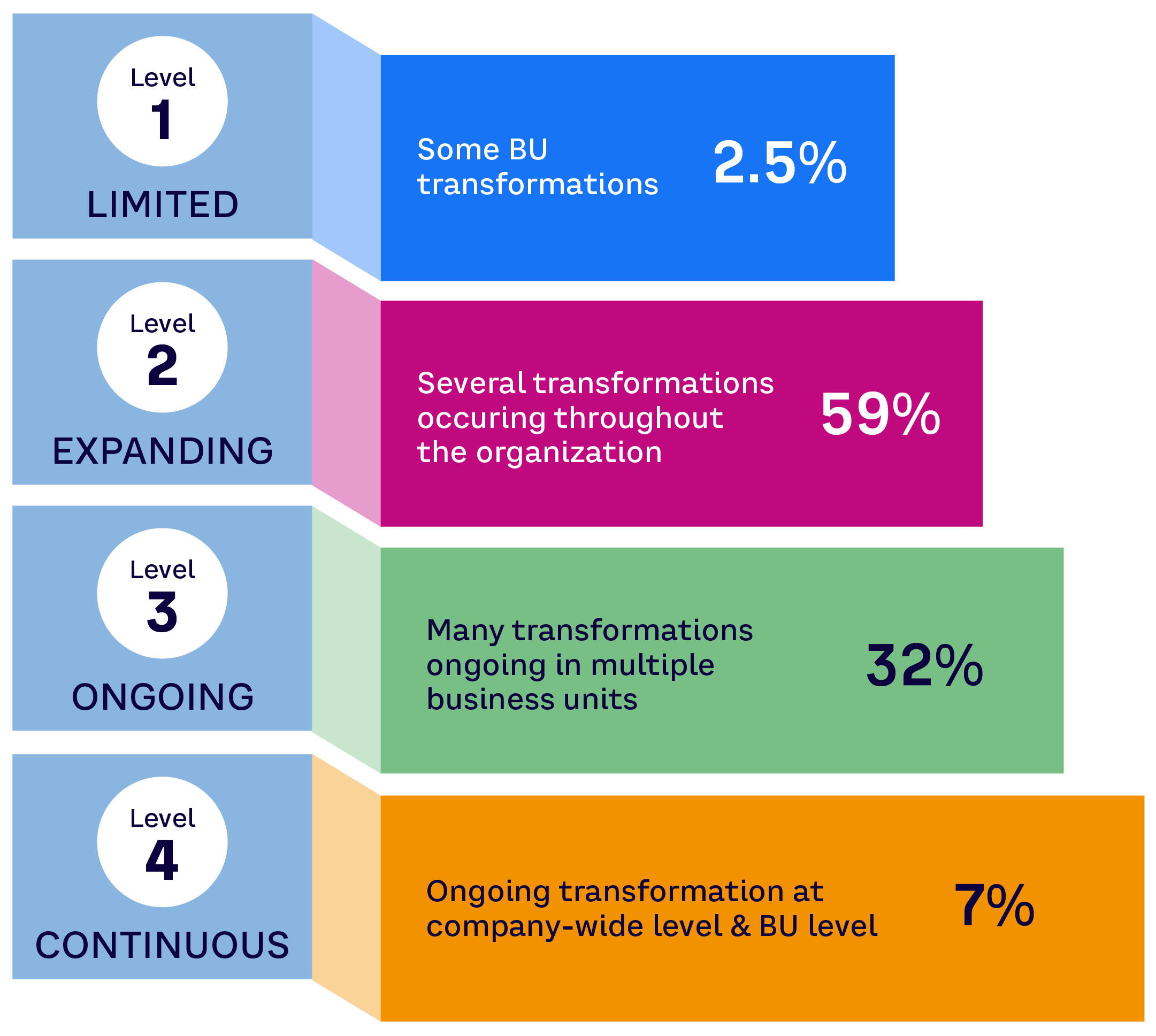
Transformation is an essential part of today’s corporate lexicon, commonly used to suggest a profound, insistent, holistic shift that the word “change” fails to convey. Arthur D. Little’s (ADL’s) 2025 annual Global Transformation Study, “Embracing Transformation in a Disrupted World,” found that 65% of major businesses are engaged in serious, organization-wide transformation, with nearly 60% running multiple programs.
Transformation maturity levels
Source: Arthur D. Little
A look at the annual reports of major businesses provides a fast fact-check. The word “transformation” appears in almost every one, often dozens of times. Companies as varied as HSBC (“profound strategic transformation”), UPS (“Transformation 2.0”), JPMorganChase (“transformation is a constant effort to improve”), and GSK (“transformational innovation”) have embraced the idea.
Interestingly, ADL data shows that 37% of firms rate themselves as only averagely engaged in their transformational ambitions. Transformation is an ever-more-important strategic imperative, but large, multiyear transformations may become less effective over time because businesses are continuously attempting transformation without fundamentally improving. An important part of the answer lies in better crafting and implementing the chief transformation officer (CTrO) role and understanding what’s been holding it back so far.
Twin disruptors
Some factors driving transformation are glaringly obvious. The two narratives dominating news agendas post-pandemic (the threat to globalization epitomized by the deployment of transnational tariffs and the revolutionary effects of generative AI) show the extent to which geopolitics and technology are now twin forces of disruption for large businesses (see the PRISM article “Turn to Face the Strain: How Business Leaders Are Adapting to Post-Globalization Changes”).
Francesco Marsella, Global Head of ADL’s Growth practice, says transformation is “a strategic answer to uncertainty and volatility” in such circumstances. And ADL’s Global Transformation Study, which polled 400 senior managers responsible for transformation in companies across the globe, found that regulatory change, technological disruption, and shifts in consumer behavior are the key forces behind transformation.
“It’s about preparing for the unpredictable and preparing the company culturally,” says Marsella. “That’s particularly the case for incumbents — very large companies that have dominated their sectors for decades. They need to change attitudes and mindsets to make their people more independent and entrepreneurial to grasp new opportunities.”
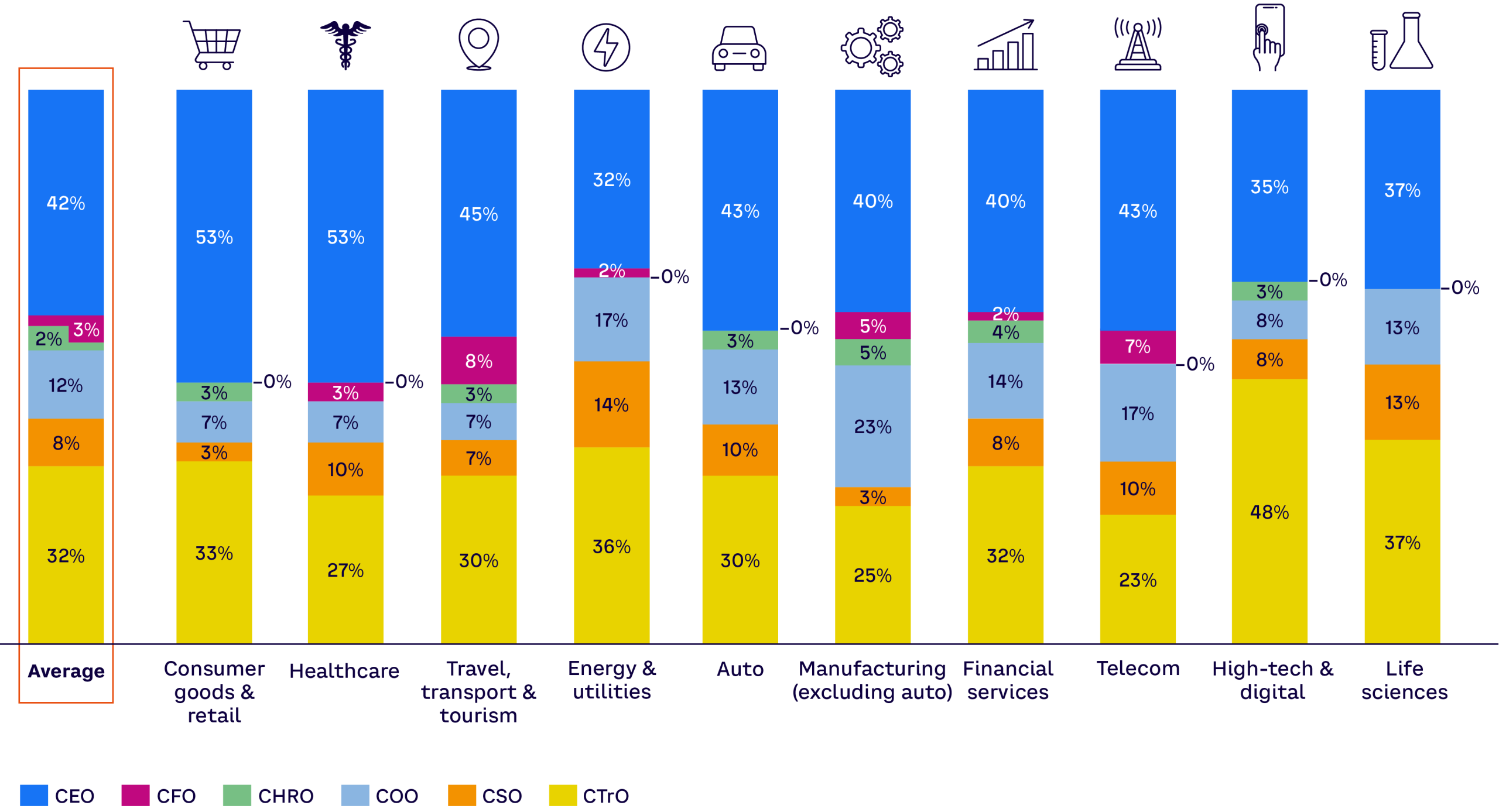
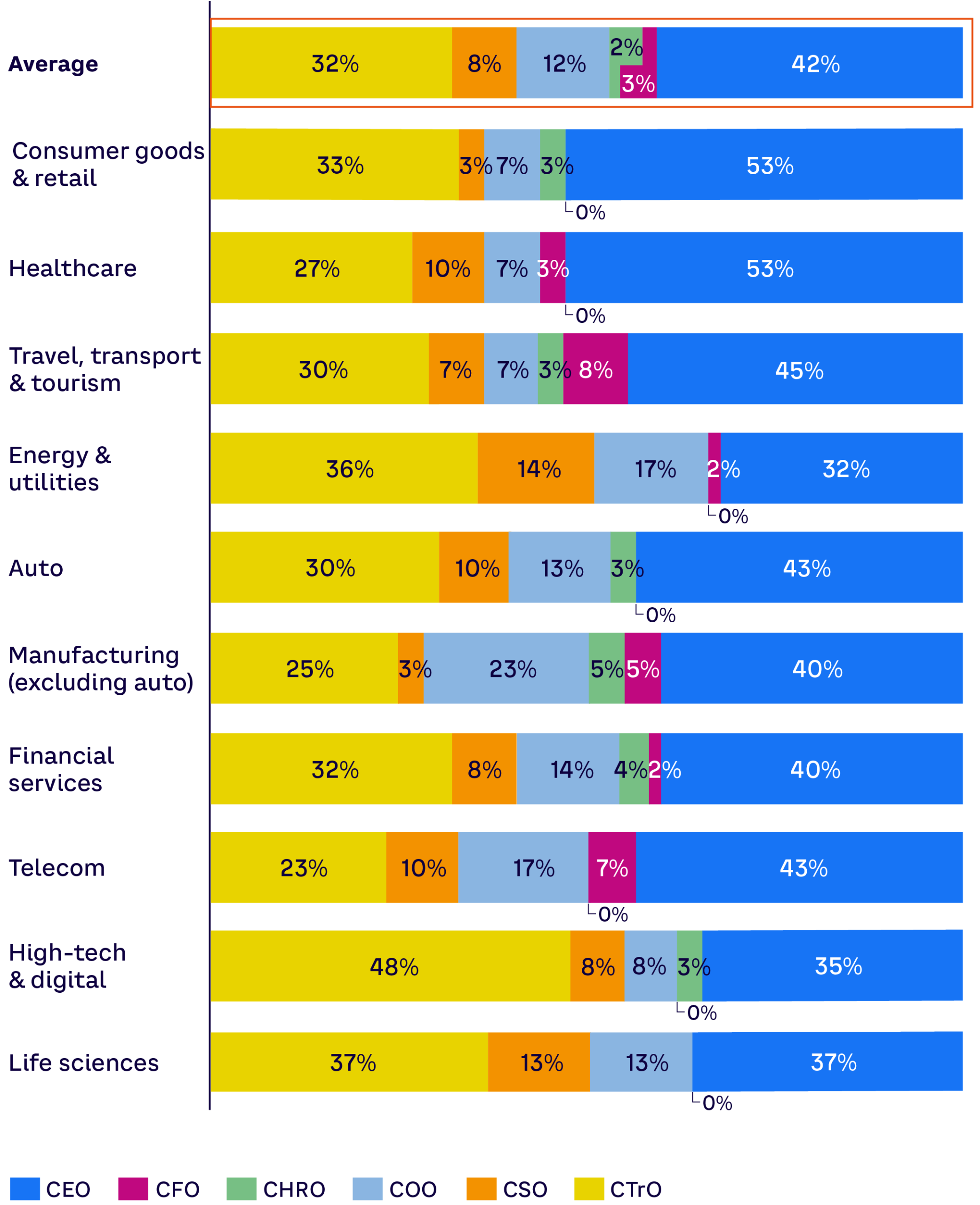
Into this whirlwind, step the growing ranks of CTrOs. The role emerged more than a decade ago, emanating first from the tech industry as buyout firms and private equity began to demand deep-seated change in the companies they acquired. Soon it became a way to signal, and often achieve, market-moving shifts. ADL found that 32% of organizations have a CTrO in place, but there’s a wide variation by sector and geography: a majority of European companies employ the role, compared to just 5% in Asia-Pacific.
Transformation is a strategic answer to uncertainty and volatility
Who is leading company-wide transformation initiatives?
Source: Arthur D. Little
Across the FTSE 100, a total of 41 businesses have at some point employed a CTrO. That includes 21 that currently have someone in the role and another five with a C-suite employee who has a clear transformational brief, as well as 15 that previously had a CTrO and either did not replace the role or are currently advertising it.
Transformations run the gamut
Recent CTrO appointments in major businesses cut across banking, leisure, and retail, among other sectors. In a high-profile hire in 2023, Rolls-Royce appointed Nicola Grady-Smith as CTrO to help overhaul a business that CEO Tufan Erginbilgic described as a “burning platform,” battered by the collapse in air travel during the COVID-19 pandemic. The turnaround appears to be bearing fruit, with the firm’s share price reaching an all-time high in 2025 amid strong revenue growth. Another example is Dan Poland, who was promoted in 2024 to the CTrO role at Campbell’s to “accelerate business performance” and “drive continuous improvement” amid a multiyear realignment of the business.
Circumstances are forcing companies to reexamine their fundamental drivers, which in turn encourages them to view transformation as essential to future growth, says Florence Carlot, Partner in ADL’s Energy, Utilities & Resources practice. “In the past, CEOs launched a couple of programs and called it transformation. Today, companies are required to constantly review their core business model, something they used to do only every 10 or 20 years.”
Marsella says he sees two major archetypes when it comes to transformations. One is a more traditional shift between two clearly defined points, in which the CTrO is a “torch carrier” for transformation. The other, prevalent among larger multinationals, is a series of “small bites” that build into a continuous transformation (see ADL’s annual 2025 CEO Insights report “Proactively Embracing Change”).
If the latter is fast becoming the preferred form of transformation, as he suggests, it requires an empowered CTrO with a voice in the organization. Yet ADL found that only 53% of CTrOs report directly to the CEO, and 41% do not specify a reporting line. An unfortunate 6% sit two rungs below the C-suite. CEOs, Marsella says, need to not only introduce CTrOs and their remit to the rest of the organization vocally and publicly, but they should co-own the transformation process as it progresses, in effect becoming program cosponsors.
Understanding the CTrO role
There appears to be fundamental confusion and misalignment about what a CTrO does and how. That isn’t surprising, given the way the role has evolved across radically different sectors. The background of CTrOs is far from uniform; of the 26 people currently performing the role in the FTSE 100, seven previously held primarily strategic roles, six were CEOs in other businesses or major subsidiaries, and six worked in operations. Another four mainly held transformation roles, with lesser representation for HR (two) and finance (one). Fourteen of the group were internal moves, and 12 were hired externally.
There is no one-size-fits-all profile for a CTrO, explains Marsella, but as a rule of thumb, CEOs should look for someone who balances an understanding of the industry and the broader challenges it faces with sufficient distance from the current workings of the business. Most likely, that means someone from outside the current board.
José Luis Álvarez, professor of management practice at INSEAD (France) and coauthor of The Changing C-Suite: Executive Power in Transformation, agrees and says the ideal candidate should have hands-on experience of value creation in their sector. “It is a subtle equilibrium between knowing the territory — not necessarily the products or technologies, but certainly the people — but not having personal ties to the old way of doing things,” he says.
The question of how to ensure a CTrO can operate effectively, with a clear mandate, is even more critical. ADL’s Global Transformation Study outlines an action plan involving extensive workforce planning to identify strategic gaps in skills and capabilities, creating a capacity-building program to future-proof the workforce, and developing new ways to mobilize and transform individuals within the organization.
In keeping with the idea that the heart of transformation is people-centric, Carlot says it is essential that the fundamental investment in any change program is a dedicated resource given “legitimacy and authority” by the patronage of the CEO and the broader C-suite. “You need to make sure your ExCo is convinced about transformation, because they will be the best ambassadors to the rest of the company,” she says. The structural positioning of the transformation function is therefore important.
Álvarez says some creative thinking can help here. He points out that most CEOs have “kitchen cabinets” or inner circles that represent an informal nexus of power. They could consider introducing the CTrO to this arrangement, ensuring they are taking part in vital operational discussions while keeping transformation a constant on the agenda. This also offers a way to overcome blockages or cultural resistance to change without airing such issues in a board environment.
Alternatively, he gives the example of Nestlé, which some years ago made a CTrO an “exceptional” member of the executive committee, which sent an immediate signal to other leaders. He says a less-rigid solution like this will work as long as CTrOs are given a very clear mandate and rules about who and what they can access and, ideally, are assigned a resource (perhaps the COO) as a key liaison.
There is no one-size-fits-all profile for a CTrO
How CEOs can help
The CEO’s most critical role in the transformation process, after setting the remit, is to lead communication and identify individuals who can disseminate the message. As Marsella puts it, “[He or she should] cascade down to the first line of reports and then to the rest of the company the reason the company is spending so much time and money on the transformation, creating a vision and aligning people behind it.”
Of course, Álvarez adds, leaders must be judicious in what they communicate. Transformation naturally leads to trepidation among the workforce, and a running commentary on the process only heightens fears. Communicate priorities and successes, he says, but do so sparingly and be clear that individuals will be provided an opportunity to develop the skills and competencies they need to thrive.
The CTrO’s role is to act as a metronome, keeping the pace of transformation steady. Unlike employees who need relatively targeted, infrequent communication, the way to convince the C-suite is to deliver regular “quick wins,” says Marsella. AI, which is at the heart of so many transformations, can be a useful tool here, offering an opportunity to bootstrap current transformation processes. Marsella suggests setting AI-driven tasks in each major area of the company with the aim of reducing complexity, with teams reporting back as often as weekly on how these projects are progressing. This gives an immediate sense of how quickly change can happen and overcomes the organizational torpor that tanks so many change efforts.
The CTrO’s role is to act as a metronome, keeping the pace of transformation steady
The human factor
Even the best-intentioned and resourced transformations will not succeed, ADL found, if they cannot reskill employees, reduce complexity rather than add to it, and alter organizational structures — something only 45% of surveyed companies are undertaking.
Humans’ tendency toward resistance should not be underestimated. Many transformation efforts flounder on internal politics: Marsella notes that when change is suggested, almost every manager will claim their culture is unique and their mission too delicate to be rethought. CTrOs can counter this by focusing on a target that can be achieved in a matter of weeks and months, and the next milestone beyond that, with longer-term transformation goals spoken of as a guiding context rather than the main thrust.
It goes without saying that success must be measurable. Financial metrics remain the most commonly used benchmark for transformation, according to ADL, but they are lagging output indicators. Álvarez says it is more useful to look at how many people are committed to changing their skills and behaviors and/or how many are using new technologies. Marsella advises measuring informal levels of collaboration between various functions, perhaps using email exchanges or meetings as proxies. Only in the long term, he says, should top-line KPIs come into the picture.
Judging success
Transformation can usually be judged a success when it becomes an organizational muscle to be flexed whenever required — what ADL calls a “diagnostic discipline” and Marsella describes as “making the business able to respond to something it can’t predict today.” He explains that prediction is no longer a substitute for clear strategy. “We’ve spent a long time discussing the future of business, but companies now need to transform. That means something that goes beyond one or two departments to fundamentally touch every person who works at the company,” he says.
ADL’s research elaborates on this distinction between unstructured transformation and meaningful, continuous transformation. In the latter state, companies think several moves ahead. Carlot cites Netflix, Apple, and Octopus as firms that, despite enjoying leadership positions in their markets, consciously shifted their business models to anticipate challenges and take advantage of new revenue opportunities.
Therein lies perhaps the greatest challenge — almost every leader can articulate the case for change, but organizational entropy and human nature can turn transformation into a slog. Market dynamics dictate that not every CTrO works in a business sufficiently innovative or instinctive to follow Netflix’s lead, yet 95% say their current transformation is on track — an interesting contrast.
Organizational entropy and human nature can turn transformation into a slog
Key takeaways
- CTrOs are multiplying, but many lack true authority.
- People, not processes, decide whether change sticks.
- Start small, move fast — quick wins build momentum.
- AI can drive progress if it simplifies, not complicates.
- Find a way to measure behaviors and culture, not just financial wins.