


14 minute read
Apr 2025
CONTRIBUTORS

Florence Carlot
Partner, Energy, Utilities & Resources

Marten Zieris
Partner, Transformation

Kurt Baes
is the Managing Partner of Arthur D. Little’s Brussels office and a member of the Energy, Utilities & Resources practice.

Thomas Oosterlinck
is a Manager in Arthur D. Little’s Brussels office and a member of the Energy, Utilities & Resources practice.

Maurane Deboutte
is a Manager in Arthur D. Little’s Brussels office and a member of the Energy, Utilities & Resources practice.

Yoran Van Houdt
is a Business Analyst in Arthur D. Little’s Brussels office and a member of the Growth practice.
In today’s rapidly evolving society, being customer centric is a critical differentiator for organizations striving to gain and maintain a competitive edge. It’s well-known that conventional organizational structures, characterized by hierarchies and silos, are often inadequate when looking to respond to the dynamic needs of today’s customers.
Enter the product operating model (POM) — a transformative way to align an organization’s structure, processes, governance, and culture around the design, delivery, and continuous improvement of customer-centric products, whether physical or virtual goods or services.
While this model is already standard in the digital space, it also has significant potential for traditional, non-digital industries. In this article, we explore the essence of the POM, its benefits, and the key success factors (KSFs) to overcome barriers to its adoption in non-digital sectors.
Prioritizing the Customer in a Rapidly Evolving World
Companies face a range of external forces that demand constant adaptation — economic shifts, geopolitical pressures, social trends, technological progress, and regulatory changes. Failing to evolve in response to these trends threatens the ability to operate effectively, remain competitive, and meet customer expectations. Importantly, these are not short-term disruptions but long-term trends that require companies to transform by building resilience, agility, and adaptability into their organizational design and operating mode.
Digital/IT departments and digital-native companies such as Amazon and Netflix have long been familiar with facing and, indeed, benefiting from rapid change. They thrive in fast-moving markets where constant technological shifts, consumer behavior, and competitive forces are the norm. Agile, data-driven decision-making, a readiness to pivot, and a focus on the customer are ingrained in their DNA.
Today, traditional or pre-digital companies, otherwise known as “digital transformers,” which once operated in relatively stable and predictable markets, face similar pressures. This requires them to adapt and embrace agility and flexibility. However, given their structures, size, and ways of operating, this can be much more difficult to achieve. For example, they are often built around expensive physical assets, such as factories, with long development and investment cycles that hinder agility.
Focusing on customer centricity is essential for them to win in these dynamic environments. Organizations that prioritize their customers are better positioned in a world where technology, market dynamics, and consumer expectations constantly evolve. Customer-centric companies understand their customers’ needs, pain points, and desires, allowing them to respond quickly to changing preferences and market conditions. Customer centricity also fosters loyalty, which is vital in competitive markets offering extensive choice. By aligning their operating model around customers, all organizations (digital and non-digital) build a strong foundation that enables them to pivot and remain relevant, even as external forces intensify.
Using POM to Propel Customer Centricity
An operating model that aligns the organization’s structure, processes, governance, and culture around customers is a prerequisite for embedding customer centricity at an organization’s core. The POM provides the answer, as it organizes teams around end-to-end product ownership to prioritize customer needs at every step of the product lifecycle.
Understanding POM
As Figure 1 illustrates, a POM organizes employees around products — goods or services used by external or internal clients — rather than functions or divisions. This helps break down hierarchical and departmental silos that often hinder innovation and agility. By forming cross-functional product teams, a POM fosters collaboration across key disciplines for product development (e.g., design, engineering, and marketing). Thanks to a dedicated product owner with end-to-end responsibility for the product, the model also accelerates decision-making.
CONTRIBUTORS
Florence Carlot
Partner, Energy, Utilities & Resources
Marten Zieris
Partner, Transformation
Kurt Baes
is the Managing Partner of Arthur D. Little’s Brussels office and a member of the Energy, Utilities & Resources practice.
Thomas Oosterlinck
is a Manager in Arthur D. Little’s Brussels office and a member of the Energy, Utilities & Resources practice.
Maurane Deboutte
is a Manager in Arthur D. Little’s Brussels office and a member of the Energy, Utilities & Resources practice.
Yoran Van Houdt
is a Business Analyst in Arthur D. Little’s Brussels office and a member of the Growth practice.
Figure 1. POM schematic
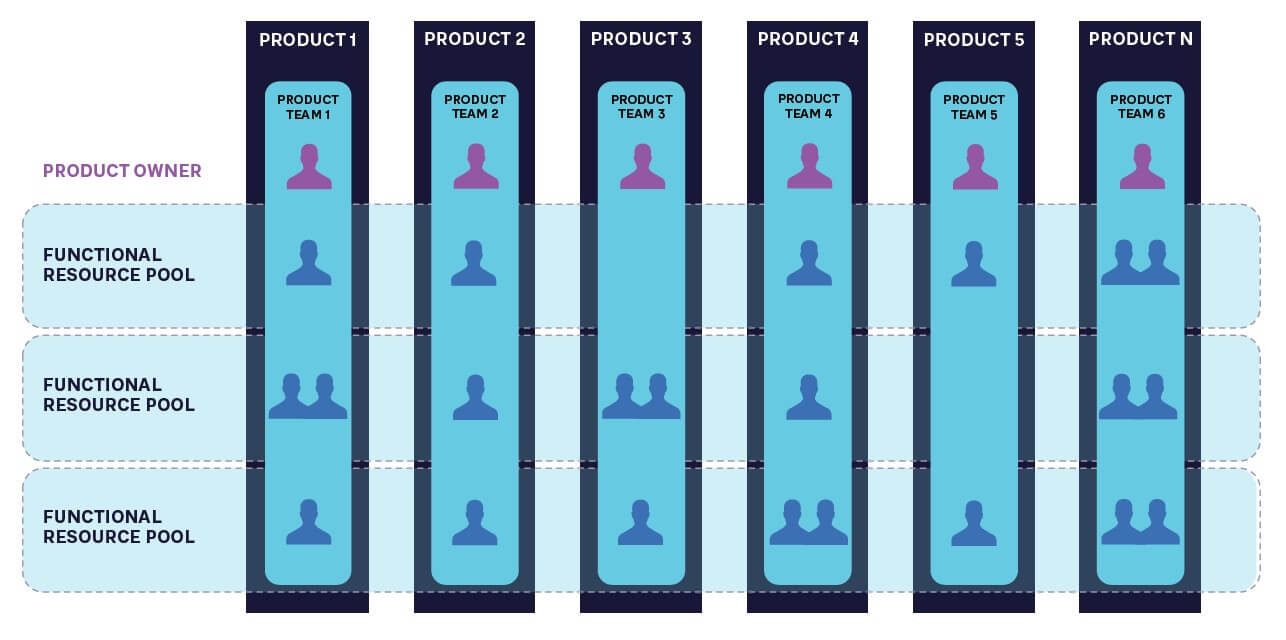
Adopting agile ways of working gives product teams the flexibility to adapt quickly to customer feedback and market shifts. Using methodologies such as Scrum and Kanban, along with outcome- oriented KPIs, multidisciplinary product teams focus on continuous improvement, accountability, and responsiveness to evolving customer and market demands.
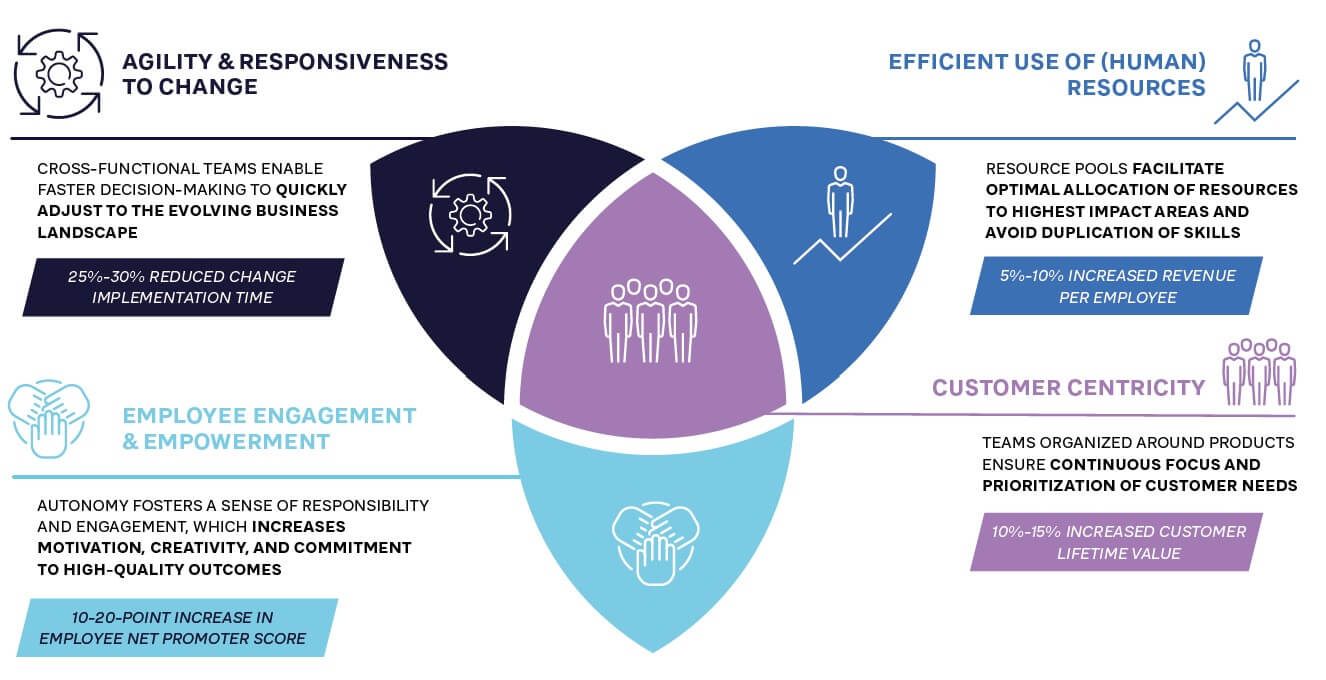
For digital transformers that need to become more customer centric to remain competitive, a POM delivers four key benefits (see Figure 2).
Figure 2. Four POM benefits
1. Enables customer centricity
The main benefit of the POM is customer centricity: customer needs are more consistently monitored and prioritized. Product teams are accountable for understanding and addressing product users’ challenges, desires, and feedback, which drives continuous improvement and value creation. Arthur D. Little’s (ADL’s) analysis suggests that organizations adopting a POM can have a 10%–15% increase in customer lifetime value (i.e., the total revenue expected from a single customer over the duration of the relationship) compared to companies not operating in a POM.
2. Improves agility and responsiveness to change
In a product-based organization structure, teams are cross-functional by default, with all required skills combined in a single team, enabling faster decision-making. As external conditions or customer expectations shift, product teams can pivot quickly, implement incremental updates, and address issues without going through complex, time-consuming approval processes.
Change implementation time, which measures the average time it takes for the company to implement significant changes from initial decision-making to go-live, can be a useful KPI to monitor company agility and responsiveness to change. ADL research indicates that organizations moving to product-based operations can reduce change implementation time from initial decision-making to final execution by 25%–30%. This is driven by the empowerment of employees in cross-functional teams to make decisions without involving multiple governance bodies and committees.
Case Study: SpaceX — Disrupting a Traditional Industry
Aerospace company SpaceX provides a good example of how agility and focusing on changing customer needs deliver success. Despite operating in a traditional, safety-conscious industry characterized by long lead times, SpaceX has outpaced its commercial-crew space- race competitors with its more agile and integrated decision-making processes. While competitors struggled with adapting to a fixed-price contract environment and faced significant internal and external coordination issues, SpaceX’s culture of rapid iteration, vertical integration, and efficient problem-solving allowed it to deliver results more quickly and cost-effectively. This meant it could carry astronauts to the International Space Station (ISS) on behalf of NASA four years ahead of its competition. Thanks to this success, its Crew Dragon vehicle will fly 14 operational missions to the ISS for NASA, compared to just six for its main competitor, which has also taken US $1.5 billion in charges due to delays and overruns with its spacecraft development.
3. Promotes more efficient use of (human) resources
By organizing people in resource pools, companies can optimally allocate their workforce to areas where they have the highest impact and avoid duplication of skills in multiple departments. Furthermore, each product team operates with clear, outcome-based quarterly goals (measurable OKRs) and corresponding budgets, allowing for better cost control and resource waste reduction, which can occur in more siloed or fragmented organizational structures.
OKRs (objectives and key results) create alignment and engagement around measurable goals. Through collaboration rather than a top-down process, they clarify what should be achieved and why.
Revenue per employee is an indicator of a company’s HR efficiency. It provides insight into how effectively the workforce contributes to the company’s overall financial performance. Our models demonstrate that adopting a POM can increase revenue per employee by 5%-10%.
4. Fosters greater employee engagement and empowerment
As product teams have ownership over their product’s lifecycle and success, this empowers them to make decisions that directly impact their customers’ experience. This autonomy fosters a sense of responsibility and engagement, as team members are more aware of the impact of their work. Empowered employees are more motivated, creative, and committed to delivering impactful outcomes, which benefits both the customer and the organization.
Engagement can be measured through the employee Net Promoter Score (eNPS), which measures the likelihood of employees recommending their company as a great workplace. ADL analysis shows this could grow by 10-20 points by transitioning to a POM. There is often also a high correlation between a high eNPS and a high customer NPS since engaged employees typically provide better customer service, supporting greater loyalty and lower churn rates.
“Focusing on customer centricity is essential for them to win in these dynamic environments”
Making Digital-Native POM Work for Non-Digital Business
Based on experience working with numerous clients, including the business unit (BU) of a German energy provider, Arthur D. Little has identified three main obstacles to successfully implementing a POM in a traditional business sector:
- Resource conflicts around shared services when multiple product owners require such services simultaneously
- The need to adopt a customer-centric and agile mindset, which can be difficult for teams accustomed to traditional operating methods in often heavily regulated sectors
- Finding the right balance between financial targets and operational KPIs, ensuring a balanced evaluation of product teams
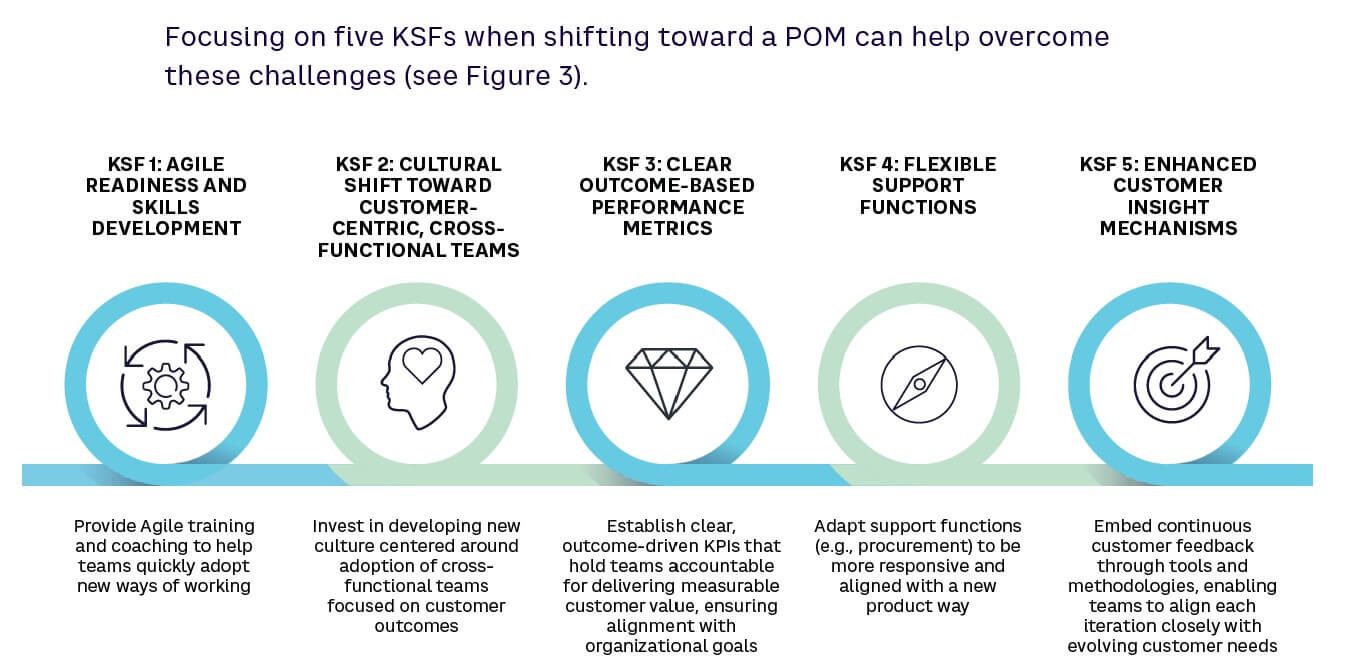
Focusing on five KSFs when shifting toward a POM can help overcome these challenges (see Figure 3).
Figure 3. Key success factors for implementing POM
KSF 1 — Agile readiness and skills development
Provide Agile training and coaching to help teams quickly adopt new ways of working.
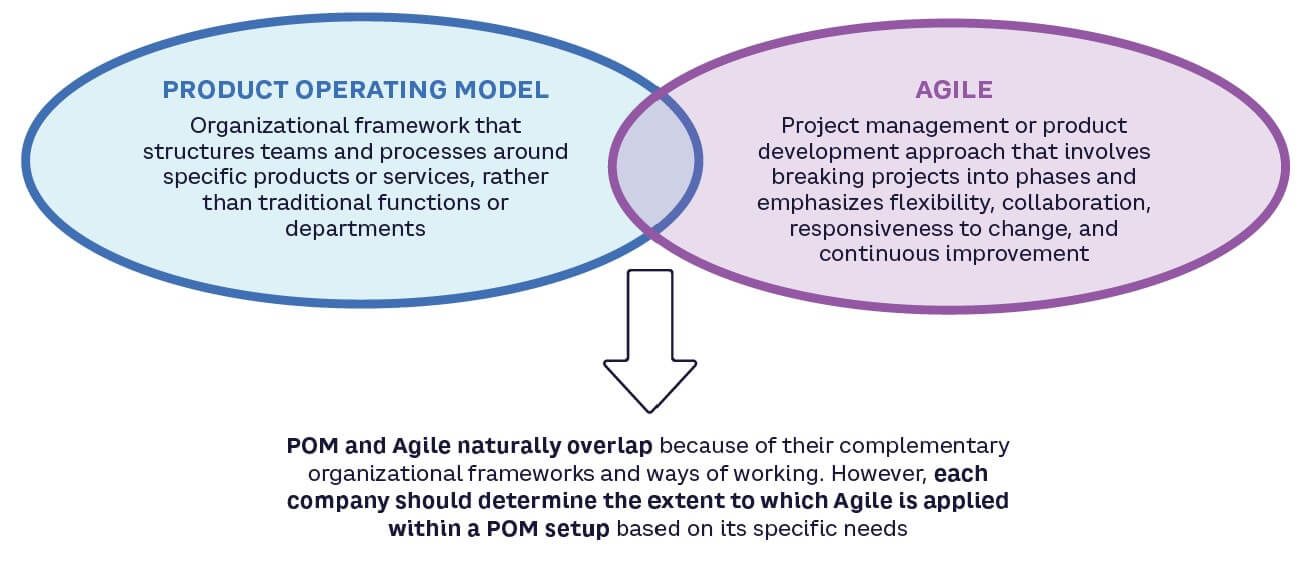
Moving to a POM requires Agile methodologies, which may be new to many pre-digital companies. The extent to which Agile methodologies are applied to a POM is a choice each company should make based on its specific needs (see Figure 4). Therefore, developing and implementing the right agile skills through targeted training and coaching enables teams to adopt iterative development processes, structure sprints effectively, and adjust quickly to changing customer needs. Subject-matter experts or certified Agile coaches can guide teams through this transition, helping establish routines such as daily stand-ups, sprint reviews, and iterative feedback loops.
Figure 4. Natural overlap between POM and agile methodologies
KSF 2 — Cultural shift toward customer-centric, cross-functional teams
Invest in developing a new culture centered around adopting cross-functional teams focused on customer outcomes.
Shifting to a POM demands a shift from siloed departments to cross- functional teams focused on realizing customer outcomes. This is often radically different from previous ways of working and cultures. Fostering a collaborative, customer-centric culture with regular training, workshops, and open forums to share information on team achievements and hurdles encourages employees to embrace these new roles and mindsets, reducing resistance and enhancing team cohesion.
KSF 3 — Clear outcome-based performance metrics
Establish clear, outcome-driven KPIs that hold teams accountable for delivering measurable customer value and ensure alignment with organizational goals.
A POM focuses on outcomes rather than outputs (deliverables) and therefore needs to be measured through outcome-driven KPIs that empower product teams to focus on realizing impactful results. Establishing clear metrics, such as customer satisfaction, time to value, and product quality, helps teams track their success and make data-driven decisions. Through measuring and steering the organization by KPIs, teams are accountable for delivering measurable customer value, reinforcing the product-centric approach in alignment with broader organizational goals.
“Shifting to a POM demands a shift from siloed departments to cross-functional teams focused on realizing customer outcomes”
KSF 4 — Flexible support functions
Adapt support functions (e.g., procurement) to be more responsive and aligned with a new product way of working.
For a POM to succeed, functions such as legal, finance, and supply chain management must also adapt to ensure the efficient provision of resources and rapid response to evolving product team needs. For example, a more flexible procurement process could involve streamlining approvals for frequently used vendors, creating preferred supplier lists, and implementing e-procurement systems to speed up purchasing. These changes allow product teams to quickly access the necessary tools and materials in response to changing customer needs and market conditions, reducing bottlenecks and enabling faster product development iteration.
KSF 5 — Enhanced customer insight mechanisms
Embed continuous customer feedback through tools and methodologies, enabling teams to align each iteration closely with evolving customer needs.
A POM depends on continuously gathering and integrating customer feedback.
Case Study — Setting Up a POM for a Solution Provider of Infrastructure Security
ADL helped a German energy provider enter the infrastructure security market by implementing a POM for one of its BUs. The design and implementation of the POM were successfully executed through a five-step approach:
- Define strategic objectives.
- Discuss operating model options.
- Describe products and operating model dimensions.
- Nominate product owners and teams.
- Go live and get iterative feedback.
The new POM organizes the BU around products, each being an independent revenue stream managed by a product owner. Product owners report to the BU head and take full accountability for the product’s financial success, including profit and loss (P&L) management, budgeting, and forecasting. The product owner is expected to drive innovation and continuous improvement in their team and ensure that all product features and enhancements align closely with customer needs. They also oversee a dedicated team and have access to cross-functional resources from engineering, design, marketing, sales, and customer support to ensure effective product development and delivery.
The model also integrates Agile methodologies and a matrix-based approach, in which product owners drive flexibility and responsiveness to evolving client requirements. The matrix structure enables product teams and shared services to work collaboratively, fostering constructive tension between the standard requirements of shared services (e.g., design and security) and the product owners’ focus on P&L optimization.
The transition to the POM presented several key challenges, as detailed in the previous section, to which effective solutions were implemented:
- Resource conflicts. Multiple product owners required shared services simultaneously, so a prioritization process was established, drawing additional resources as needed from within the client’s network.
- Shift to a customer-centric, agile mindset. Traditional teams faced difficulties adjusting to agile ways of working. Tailored training sessions were held to explain the value of agility and develop new skills to support the transition.
- Financial accountability. With financial targets heavily tied to product owners’ performance, additional operational KPIs were introduced to ensure balanced team evaluation.
Overall, adopting the POM saw major benefits, resulting in a 50% reduction in product time to market, a 70% improvement in team collaboration and satisfaction, and improved financial forecasting.
Investing in tools and methodologies for customer insights — such as customer interactions, focus groups, and user testing sessions — ensures that product teams can stay in tune with evolving customer needs by listening to and acting on the customer’s voice. By embedding customer insights into every stage of the product lifecycle, organizations ensure that each product iteration and improvement aligns closely with customer expectations, reinforcing a customer-centric approach.
Insights for the Executive
Becoming more customer-centric and agile can be achieved through process and governance changes, but these often fall short of delivering the necessary transformation. A shift to a POM can provide the needed step change. In this transformation journey, senior management should focus on:
- Defining clear objectives for what they want to achieve with the POM and adapting their model and implementation journey accordingly, recognizing that the way the POM concept is applied heavily influences the benefits that it will bring
- Identifying up front which areas of their organization can benefit from working in a POM as opposed to traditional methods, also considering the investment and degree of pressure put on the people by engaging in such a transformation
- Looking beyond organizational change and addressing the full set of dimensions that underpin a target operating model, including processes, capabilities, tools, way of working, and culture
- Providing a clear storyline for the organization, explaining the need for change, the specific benefits and resolved challenges, and the “what’s in it for me” for every one of the involved stakeholders to secure buy-in and support throughout the transition
- Empowering their people by fostering end-to-end accountability for their products, recognizing that strong employee involvement is a key success factor in the transition journey