

14 minute read
Apr 2025
CONTRIBUTORS

Simon Guyomard-Norman
is a Manager in Arthur D Little’s London office and a member of the Innovation practice.

Philip Webster
is a Partner in Arthur D Little’s London office and a member of the Innovation practice.

Nicola Young
is a Consultant in Arthur D Little’s London office and a member of the Innovation practice.

Alessandro Abbondanza
is a Business Analyst in Arthur D Little’s London office and a member of the Innovation practice.
For decades, organizations in a range of industries, from retail and consumer goods to healthcare and pharmaceuticals, have claimed they are customer centric. Whether this is true or not, they now need to go further. In today’s markets, customer centricity is no longer enough for success — companies must first consider the consumer as a human being.
People’s available information sources, motivations, and actions are more complex than ever before, making their responses far less easy to characterize in terms of broad demographics. Better, more tailored insight is required to meet their individual needs, build long-term loyalty, and understand how they work and think in the real world.
At the same time, organizations must transform their products to be driven by sustainability, health, well-being, and regulatory or cost drivers. When doing this, they need to ensure they are making the right trade-offs to meet customer requirements and their own objectives to thrive.
This means companies need to better understand how and why humans make decisions. This can help increase brand and product loyalty by, for example, reducing the frustrations of consumers on “hold” in a call center or increasing brand “stickiness,” which means people will choose a particular product time and again.
This is driving organizations to invest heavily in building behavioral science capabilities (e.g., cognitive psychology, sociology, and anthropology) and changing working practices (both internal and external) to embed human-centric research into new — and more sustainable — products and services. While digital players have led the way, industries such as consumer and luxury goods are now beginning to excel in this area. However, in many other industries, this capability barely exists or is focused on the end of the product R&D process rather than being a core driver of innovation.
It is increasingly vital that organizations in all business-to-consumer (B2C) sectors successfully embed behavioral science within R&D and deliver human- rather than just customer-centric products and services. As this article explains, the key is to develop and embed behavioral science across the R&D process to truly understand the individual customer as a person, using this insight to meet their specific needs.
Understanding the need to be Human centric
Customers expect businesses to treat them as individuals. They expect a human-centric experience with tailored products and services, using context and nuance to meet their specific needs rather than being pigeonholed as part of a broader demographic group. Human centricity is a step beyond customer centricity. Rather than focusing on improving sales in isolation, it aims to create products and services that truly meet people’s needs at a fundamental level.
The need for human centricity is not new, but growing requirements for brands to change their portfolios are accelerating it for a range of reasons:
CONTRIBUTORS
Simon Guyomard-Norman
is a Manager in Arthur D Little’s London office and a member of the Innovation practice.
Philip Webster
is a Partner in Arthur D Little’s London office and a member of the Innovation practice.
Nicola Young
is a Consultant in Arthur D Little’s London office and a member of the Innovation practice.
Alessandro Abbondanza
is a Business Analyst in Arthur D Little’s London office and a member of the Innovation practice.
- Meeting consumer needs for greener products, adhering to regulatory changes, and delivering on corporate sustainability targets mean changing product and packaging specifications.
- Health and well-being. Changing tastes as people move toward inherently positive choices rather than the “least bad,” combined with legislation (e.g., sugar taxes), push companies to update product recipes — ideally without sacrificing taste or impacting the overall consumption experience.
- Rising prices and the limited availability of certain ingredients or components lead to enforced product changes that must be managed correctly.
Humans are hardwired to be suspicious of change, so making changes involves trade-offs. For example, suppose an organization is making updates to improve health or embodied carbon outcomes. In that case, it will have to fight against some real downsides (even if it’s as “simple” as cost) and work out what the consumer values. With marquee consumer brands, any change to best-selling products is seen as bad by customers, staff, and investors, even if it is part of achieving a more positive overall outcome.
“Get closer than ever to your customers. So close that you tell them what they need well before they realize it themselves”
– Steve Jobs
Introducing Behavioral Science
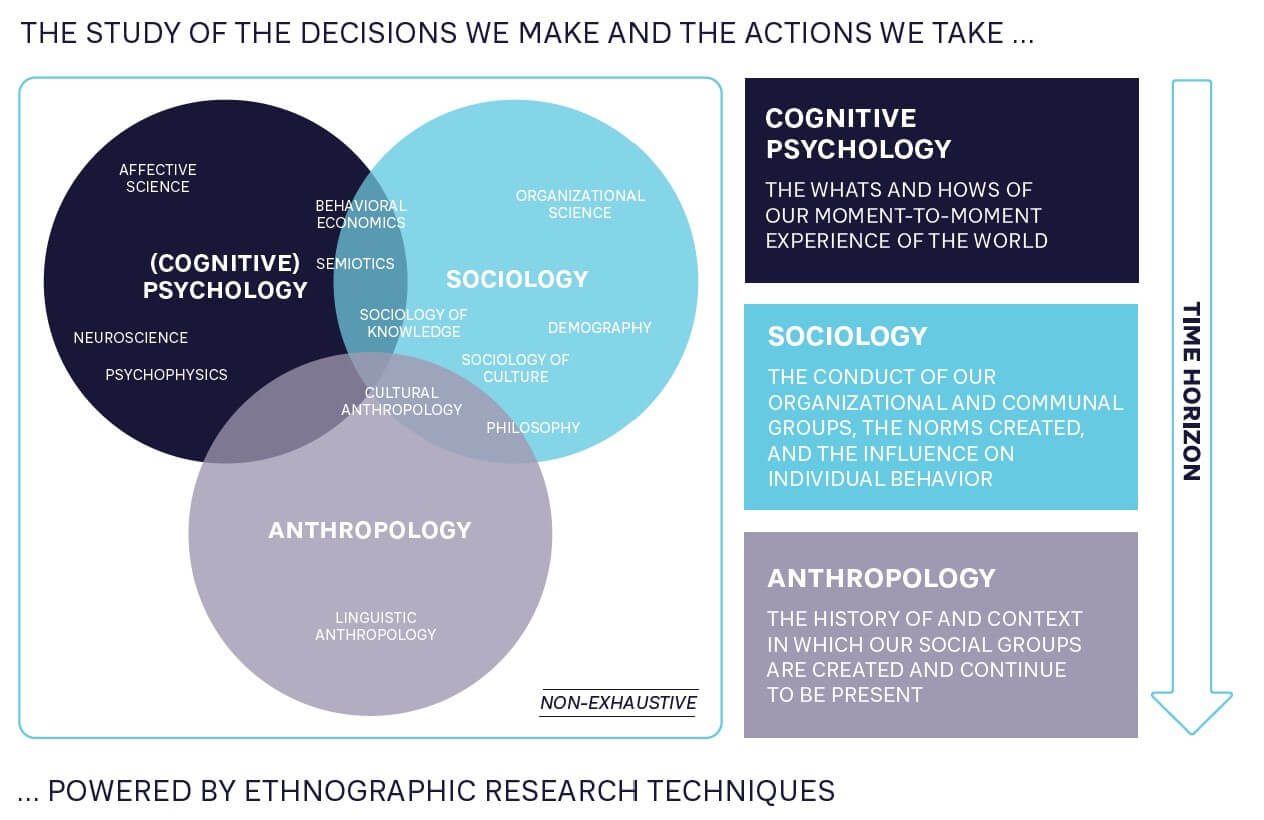
Behavioral science — the study of how people react to internal or external stimuli — is key to becoming more human centric. As Figure 1 illustrates, it is an umbrella term for several disciplines that help us understand how and why decisions are made across different timescales of action.
Figure 1. Interlocking disciplines within behavioral science
Behavioral science is necessary, as humans are not rational actors; understanding reasoning, motivation, and choice is complex. For example, it is reasonably well established that round-shaped chocolates (e.g., chocolate buttons) taste sweeter than “sharp” chocolate, even with the same recipe. However, we need a holistic behavioral science approach to know if this is a physical response potentially linked to melting behavior in the mouth or a social response based on perceptions of smoothness or softness or other associations. Despite patients understanding that medicines benefit them, noncompliance with medication regimes may be up to 75%, varying substantially across demographics and nations. How can healthcare providers better understand patient behavior throughout treatment to redesign medical interventions appropriately? This links closely to the well-known work of Nobel Prize winner Richard Thaler on “Nudge Theory”: the application of behavioral sciences to influence change.
Behavioral sciences, therefore, provide an important counterpart to rational economic models of R&D, which primarily examine measures such as net present value (NPV) across a portfolio. Indeed, the subfield of behavioral economics focuses specifically on how psychological, sociological, and anthropological factors influence economic decision-making.
“It is increasingly vital that organizations in all B2C sectors successfully embed behavioral science within R&D”
The Use of Behavioral Science Today
Behavioral scientists are particularly active in fast-paced digital environments, focusing on user experience (UX) improvement, friction reduction, and other UX optimization forms. According to a case study by InsideBE, the mindfulness app Headspace noticed that new users were frequently overwhelmed by the volume of content and meditation courses it offered, leading to decision fatigue and churn. Redesigning the onboarding process, setting default courses for new users, and increasing engagement through gamification elements improved user retention by 34%.
The job of behavioral scientists in these digital environments is made easier by the volume of instantly available data on user behavior while on the app and the ability to test multiple improvements to optimize the experience quickly. This level of detail is much more difficult to capture for “real-life” products. However, leading consumer packaged goods (CPG) companies — and others — are successfully using behavioral science to become more human centric and solve trade- offs in product R&D; for example:
- Unilever has partnered with the University of Manchester, using neuroscience approaches to understand the perception of food.
- Flavor and fragrance company Givaudan uses a digital platform and consumer headsets to study neurological responses to food to help its customers deliver healthy products and meet consumer expectations.
- Proctor & Gamble redeveloped a sustainable (cardboard) packaging concept after behavioral science insights highlighted that consumers found the system unsatisfying. The original prototypes lacked audio feedback when properly closed (no “click”). Resolving this issue substantially improved acceptance of the new packaging format.
- Volvo credits behavioral science as being key to its program to enhance vehicle safety, using the principles to understand driver behavior and then develop systems to anticipate and correct human errors.
- The e-health company Adherium has developed a smart inhaler, which has been clinically proven to ensure that patients adhere to the use of their asthma medication at the right time and with the correct dosage. It does this by providing real-time feedback to both the patients themselves and their physicians, increasing correct drug usage by up to 180%.
- As noted in Behavioural Sciences for Better Health, The World Health Organization (WHO) is building behavioral science partnerships2 to investigate and “solve cognitive, social, and environmental drivers and barriers that influence health-related behaviors.”
Challenges to Becoming Human Centric
Many organizations already employ behavioral science teams, with the profession growing in size and influence. According to a research report published by Markets and Markets, the market for behavioral science services (agencies and consultancies) is expected to grow alongside industry headcount at nearly 20% year on year until 2029.3 This will be partially driven by applications in cybersecurity alongside the core human engagement pieces. However, despite these efforts and investments, the successful integration of behavioral science to enable human centricity faces five key challenges.
1. Behavioral scientists are usually not within innovation/R&D teams
Currently, most behavioral scientists are likely to be in teams within the commercial arms of organizations, such as the marketing and consumer insights functions. This means they are separated from innovation and active R&D and generally tasked with managing a go-to-market process and monitoring market sentiment. Where (conventional) consumer research teams are situated within R&D, they are typically tasked with validating products created by developers rather than directly impacting their creation. Outputs can feel like box-ticking exercises or be used to feed into pricing discussions.
2. Brand guidelines are too rigid
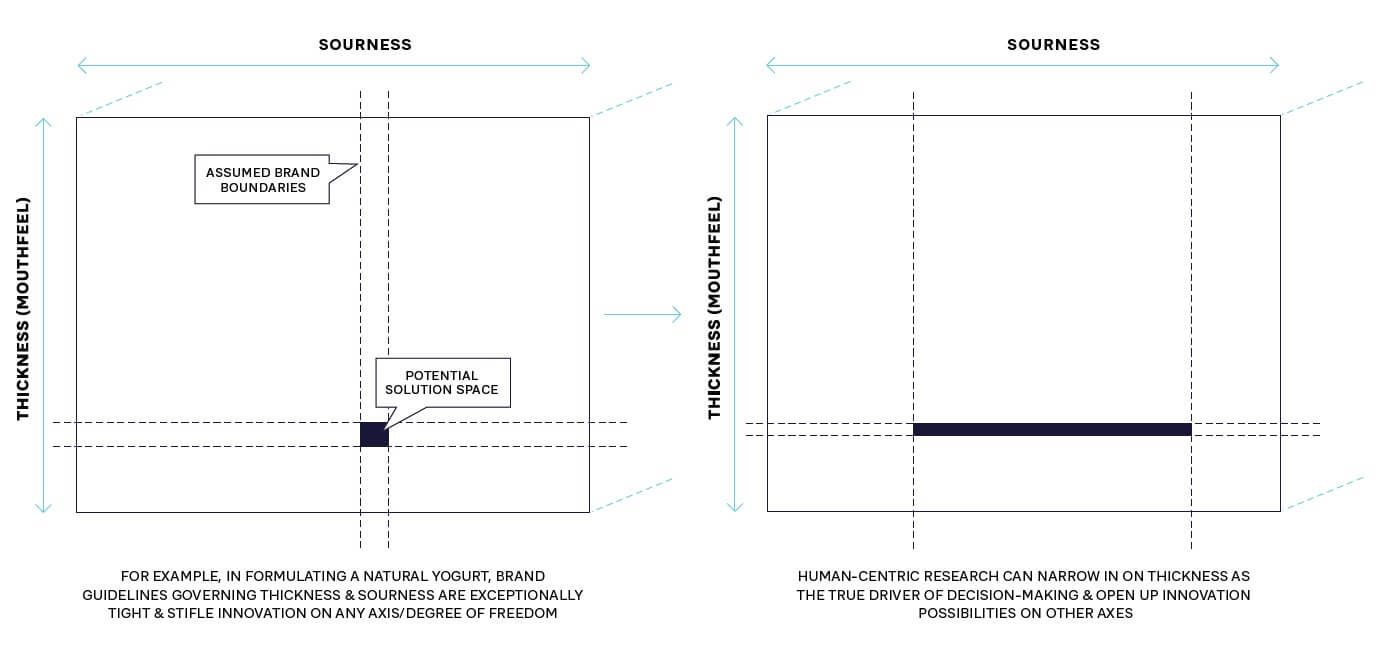
In many cases, conventional brand guidelines are too restrictive and limit the scope for innovation. They accept consumer pushback against change at face value and do not test more complex decision- making or the neuroscience that drives human actions. In general, humans are more adaptable than brand stewards assume — as long as the key guardrails around product quality and price are met — which can open up the innovation space (see Figure 2). However, developing nuanced technical guardrails based on behavioral science insights is time-consuming and requires a proactive approach.
Figure 2. Opening up the innovation space with behavioral science
3. Outcomes can focus on the wrong metrics
Focusing on the right research metrics during early concept development is essential. Many marketing consumer insight tools look to statistically quantify outcomes, such as the potential financial reward a product may deliver when it is finally launched, which is difficult to predict at such an early stage. Instead, the focus should be on the person who will use that product, their specific needs, and how they will be met.
4. Behavioral science is more expensive and time-consuming than traditional research
In many cases, conventional brand guidelines are too restrictive and limit the scope for innovation. They accept consumer pushback against change at face value and do not test more complex decision- making or the neuroscience that drives human actions. In general, humans are more adaptable than brand stewards assume — as long as the key guardrails around product quality and price are met — which can open up the innovation space (see Figure 2). However, developing nuanced technical guardrails based on behavioral science insights is time-consuming and requires a proactive approach.
5. The importance of credibility and being seen as using behavioral science for goods
As with any activity that affects behavior, behavioral science can be used to manipulate people, such as influencing them to choose less healthy or more profitable options for the company or making consumers feel guilty for opting out of an online subscription. Organizations, particularly large, consumer-focused businesses, must overcome a credibility gap with consumers, who may not believe they are motivated by a desire to understand and deliver on their needs if it impacts revenues.
“Focusing on the right research metrics during early concept development is essential”
Two key principles to gain more benefit from behavioral research
To overcome the challenges and help businesses move beyond customer centricity toward human centricity, behavioral research needs to focus on two core principles.
1. Shifting consumer research from risk avoidance to value creation
Traditionally, consumer research has focused on smoothing the launch and adoption of new products. That means it is considered a reactive, risk-avoidance mechanism introduced late in development when significant product decisions have already been made. Organizations need to change the narrative, treating human-centric research as a positive value-creation measure. This could mean, for example, using behavioral research to help predict how well a product will perform or develop a product in a virtual environment before using expensive consumer insight or piloting assets.
2. Embedding human-centric research throughout the R&D process
R&D processes should ensure that proactive, human-centric research is an integral element that feeds into the product or service pipeline. This requires organizations to redesign their innovation processes and guarantee that the right resources, time, and budgets are available for the consumer research team to carry out behavioral science programs. Human needs should be the starting point for programs and be better validated throughout the R&D pipeline, not just at the end. This could be done by assessing progress against human goals at every project stage gate alongside common metrics, such as forecast risk-adjusted NPV.
Case Study — Behavioral Science in Action
Arthur D. Little (ADL) is working with several leading CPG businesses to reengineer R&D teams to take a more human-centric approach. This includes building new behavioral science capabilities to drive health and sustainability innovation by creating internal teams or leveraging wider ecosystems.
In one example, ADL worked with a food and beverage multinational on future capability requirements and an operating model for a new consumer and sensory science team to act as the interface between new product development and consumers. The team had been challenged to develop a new value-adding strategy, having spent previous years focusing on cost-avoidance measures and streamlining operations.
Behavioral science was identified as a key enabler for the function’s future, supporting the business’s wider goal of becoming human- centric. Alongside specific initiatives to develop behavioral science capabilities (by hiring new colleagues and building relationship networks with agencies), new ways of working were profiled in collaboration with key product development stakeholders and are now being rolled out.
The key ongoing challenge for the function is balancing the day-to- day mandate to provide rapid tactical advice of continuing product development with value-adding behavioral science insights in the early stages of innovation. Communication is also needed to educate internal customers about the function, the benefits of the new capabilities, and “what questions to ask” to get the most out of the capability investment.
Insights for the Executive
Effectively delivering a human-centric approach is increasingly critical for all organizations as changing customer, regulatory, and cost requirements drive transformation of products and services. Success requires focusing on:
- Creating senior-level understanding of the value-creation possibilities of behavioral science, moving away from the reactive benefits that traditional consumer research delivers.
- Building credibility with customers and the wider market by setting a clear strategy for how behavioral science will be used, along with guardrails to demonstrate a commitment to good practice that is truly focused on the needs of the individual.
- Hiring, educating, and cross-training R&D team members so they have the behavioral science skills and backgrounds to embed human centricity into their processes and activities confidently.
- Becoming more proactive in consumer research. Teams should be encouraged and incentivized to identify interesting consumer behaviors and feed these into the start of the product development pipeline. This may mean some low-value “business as usual” consumer research must be reduced.
- Adopting the latest digital tools and techniques to draw insights from the growing volumes of semi-structured data that is now available, such as social media and loyalty schemes.
- Taking consumer research from the focus group conference room and into the real world. Organizations may need to create new agency and academic partnership ecosystems to acquire expertise and tools.
- Ensuring that every R&D project team has a dedicated voice of the consumer/human representative onboard who can feed into assessments at every stage gate.
If we accept that the consumer markets of the future are getting more complex, diverse, and fragmented (more human, we may say), the methods we use to drive our innovation processes must get smarter alongside them.