

11 minute read
Feb 2026

Stuck in Traffic


It’s a future for our cities where the car is no longer essential. The metro, bus, or train — all just a tap away. Bikes, scooters, and other micromobility vehicles are docked nearby and ready to use. And yes, self-driving cars, always around if you need a lift.
For years, a growing chorus in the mobility and tech sectors has envisioned a future where private car ownership is obsolete and traffic a relic of the past. This future promised to ease the burdens of cost and congestion by giving individuals more control — enabled by an all-in-one integrated platform, or mobility-as-a-service (MaaS), where every travel option in a city is accessible at your fingertips. At the same time, autonomous vehicles (AVs) were gaining momentum. The COVID-19 pandemic, which disrupted daily routines, amplified calls for more personalized, flexible mobility solutions.
But this urban mobility dream is still exactly that: a dream. Although MaaS exists in various forms worldwide today, our transport landscape remains siloed. AVs work, but proper governance mechanisms are still being beta-tested. And as debates rage on, car trips have only increased in the pandemic’s wake — people are driving more, not less.
Put simply, this wasn’t the future we were promised. At least not yet. Much has been written about why this hasn’t happened and how it could still happen. But is the urban mobility dream actually possible? And if so, what would be needed to revive it?
FITTING AVs INTO FRAMEWORKS
In a growing list of countries, self-driving cars and shuttles are becoming a familiar sight. In San Francisco, AVs line up outside concerts. In Shenzhen, robotaxis are just a tap away. London is set to launch a similar service in 2026. The technology, while still working out some kinks, is getting there (see Arthur D. Little’s [ADL’s] “Autonomous Mobility Journal”).
While the technology continues to advance, its success won’t hinge on sensors and software alone. “The question of adoption is less of an issue now,” said François-Joseph Van Audenhove, Managing Partner at ADL and Head of its Future of Mobility Lab. “I believe people will accept it; the trust [builds] relatively quickly. Now the real question is how to properly frame and enable these services to ensure they are well-integrated within our mobility systems.”
Two scenarios have since emerged, notes Van Audenhove. In the first — seen in the US and China — AVs replace traditional taxi and delivery services: self-driving robotaxis take over ride-hailing, and AVs deliver food and parcels directly to your doorstep. The second, more common in Europe, positions AVs as a complement to mass transit — offering first- and last-mile connections to subway or train stations, circulating around airports, or operating during off-hours and construction periods (see ADL Viewpoint “DRT: A Key Lever to Bridge Mobility Gaps”).
Both models have produced mixed results — in part, Van Audenhove says, because cities have yet to answer a fundamental question: “What will be the value of the self-driving car?” Electric vehicles (EVs) face a similar quandary: while they reduce carbon emissions, increased driving — enabled by the perception of cleaner energy — could worsen congestion. And if the energy grid isn’t fully decarbonized, emissions may still rise. For AVs to deliver on their promise, cities must define clear policy objectives (e.g., reduced vehicle miles traveled) and establish measurable pathways to achieve them (e.g., setting a target for the percentage of trips taken by AVs by 2030).
If automation is nigh, then municipalities must fit this technology into a future that provides tangible benefits to everyone. “A virtuous mobility system is like a house,” Van Audenhove explains. “It first needs to be guided by vision, policies, and governance (the roof). The floors are the supply (the different mobility services offered) and demand (influencing mobility behaviors), which need to be actively managed. These need to be supported by adequate funding, acting as the foundations of the house” (see ADL report “The Future of Mobility 5.0”).
Van Audenhove outlines a simple framework: avoid, optimize, shift. First, identify more opportunities to ask, “Do I need to take this trip?” — the “avoid” element. If the trip is necessary, how can cities and towns ensure it happens as efficiently and effectively as possible? That’s where optimization comes in. If the default mode is a private car, what incentives or measures can encourage a shift to more sustainable alternatives? Finally, the role of AVs: how can they be integrated into this broader mobility strategy? (For further insights, see ADL report “Mobility Demand Management: A Critical Tool to Influence Mobility Behavior,” a companion piece to “The Future of Mobility 5.0.”)
In cities where Waymo operates commercially, projections indicate a near one-to-one shift from Uber and taxi users following its deployment, according to Sarah Kaufman, Director of the Rudin Center for Transportation at New York University. In other words, it’s not replacing cars — just drivers. This raises a potential concern: if autonomous taxi services drive down prices, they could draw riders away from public transit, ultimately increasing congestion and emissions.
But cities have an immense opportunity, Kaufman adds, to leverage AVs to address thorny operational challenges — and in doing so, improve their (often contentious) public image. “There’s real potential to set up agreements where deployment means these companies also feed information back to the city,” explains Kaufman. “Not just about the vehicle’s safety, but also road conditions, like potholes, construction overstaying its permit, or unsafe intersections. That’s data that cities can and should require.”
"Although MaaS exists in various forms worldwide today, our transport landscape remains siloed"
MAKE MAAS WORK FOR YOUR CITY
For a time, the concept of an all-in-one mobility app was all the rage. A wave of startups rapidly entered urban markets, introducing everything from for-hire cars and bike-share programs to dockless e-scooters and shared vans. Integrating these services through a smartphone interface seemed like a natural step, especially as more aspects of daily life moved online.
Yet most systems remain fragmented. According to industry benchmarks, integration follows a tiered model: Level 0 offers basic information, like a train or bus schedule; Level 1 adds service consolidation, as seen in apps like Google Maps; Level 2 incorporates payment capabilities; Level 3 bundles services into a subscription; and Level 4 aligns mobility services with broader policy goals. For most of the world, what’s available in your pocket is probably somewhere around Level 2 — a solution that cities and transit authorities have ceded to the private market.
There are exceptions, however. Jelbi in Berlin, Île-de-France Mobilités (IDFM) in Paris, and Floya in Brussels are examples of Level 3 MaaS platforms — enabling users to plan, book, and pay for multiple public and private mobility options within a single interface. Free Now (recently acquired by Lyft) offers a similar range of services in Germany. Meanwhile, ride-hailing companies such as Uber and Lyft are increasingly incorporating third-party mobility offerings alongside their own.
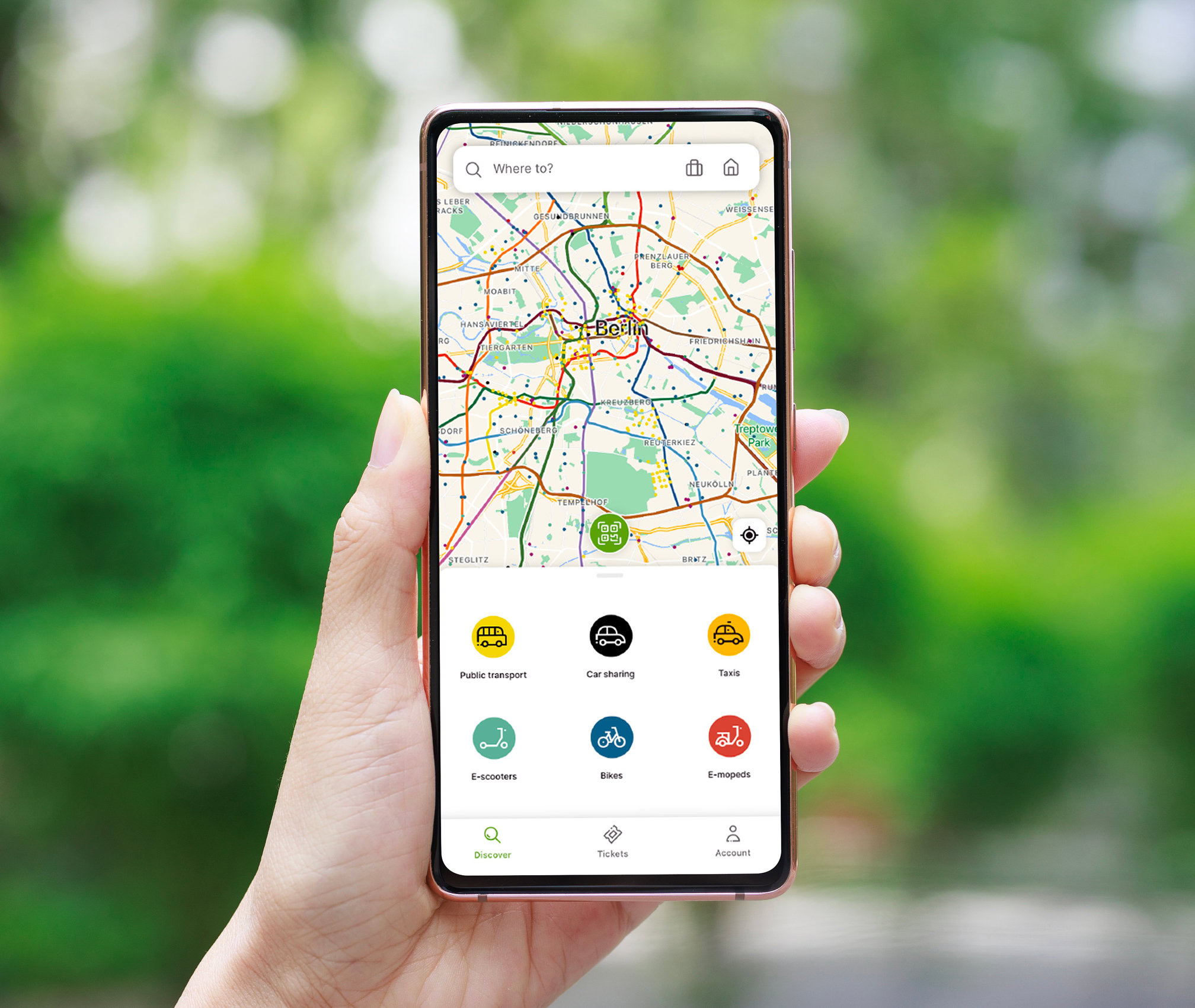
Berlin-based Jelbi app
But most MaaS experiments have failed to take off, including Whim — the original MaaS app by MaaS Global, founded in 2017, suspended operations in 2024. And there isn’t always one factor to blame. Dr. Philipp Seidel, Principal at ADL who studies new mobility services, lists several hurdles to consider. “How far did the technical evolution progress? What are the regulatory and legal questions? Then you have the business case: does it pay off? And what about the traffic system perspective? Does it solve congestion in and around cities? Does it solve accessibility or social problems? Does it solve the workforce bottlenecks?” (see ADL report “Beyond MaaS: How to Realize the Promise of Mobility-as-a-Service”).
Full MaaS integration requires cities’ transport authorities to both “frame” and “enable”: providing the right vision, appropriate funding, and governance (framing) while ensuring proper enforcement toward shared and micromobility providers (enabling). Bus service may need expansion. One provider may resist revenue sharing with another. For MaaS to succeed, every cog in the system must work in sync — with a clear objective of shifting travel behavior. This is where additional policy levers, such as road pricing, congestion charges, and parking fees, become critical enablers. And that’s before even factoring in AVs.
But the ideal of seamless, accessible transit that MaaS trumpets is gaining mainstream acceptance, Seidel points out. In most baseline scenarios today, transport providers offer digital tools to both plan and pay for trips, whether through mobile apps or contactless payment systems. While implementation varies, cities should still work to embed the core benefits of MaaS — greater transparency, ease of use, and improved connectivity — into the systems they oversee or regulate.
For Seidel, a city must care — because MaaS depends on cooperation and collaboration. “The political leadership of a city or transit agency has to embrace this technology from their perspective,” he explains. “What’s the performance of my urban mobility system? How quickly do I get people from A to B? And how satisfied are they?”
"The promise of frictionless, free-flowing movement hasn’t disappeared — it’s simply evolving"
AUGMENT THE AUTOMOBILE
For much of the past century, the urban mobility dream was shaped by the automobile. Even the name — from the Latin auto (self) and mobilis (moveable) — reinforces the idea of individual freedom and autonomy. Popular culture reflects this ideal, with cars gliding through empty roads and scenic landscapes in advertisements and films.
That dream came with consequences — rising carbon emissions, choked roads, and environments where access is limited to those with a car. Yet the automobile persists — supported by a strong business case. For many, owning a car remains just affordable enough, creating sustained demand for automakers selling millions of units each year. MaaS and AVs will need to compete in that same space. There must be a clear ROI — whether direct or indirect — that is easily understood and tangible to riders. They need to save time, money, or both. Until that value is delivered, MaaS adoption will remain limited, and AVs will largely be confined to players with the financial scale to sustain deployment — as we are seeing today.
The promise of frictionless, free-flowing movement hasn’t disappeared — it’s simply evolving. Cars are beginning to drive themselves. Smartphones can summon a ride in seconds. And mobility options are more abundant than ever. A shared solution is clearly more efficient: even EVs, which reduce emissions, do little to address the inefficiency of nearly 2 billion cars worldwide that sit idle 90% of the time.
What comes next remains uncertain. But regardless of how the future unfolds, some realities persist: today, nearly 80% of all kilometers traveled are by car. Progress will need to be incremental — but measurable. Cities should harness the dominance of the automobile to accelerate the transition toward more sustainable mobility, where cars become not the entire puzzle, but one — still important — piece of it. After all, the most widely adopted form of transportation in history still has lessons to offer.
“The shared mobility system, which includes all mobility services but the private car, needs to be sufficiently attractive to be a possible alternative for users whose automobile is the default for all trips,” says Van Audenhove. “It should embrace the car as part of the overall package, rather than positioning it in opposition to individual car use.”
"Cities should harness the dominance of the automobile to accelerate the transition toward more sustainable mobility, where cars become not the entire puzzle, but one — still important — piece of it"
Key takeaways
- Technology can be an enabler and accelerator of virtuous mobility, but it will only do so if the key building blocks — vision, supply-demand management, and funding — are in place first.
- Cities should work with private operators to custom-fit concepts of MaaS for specific settings, with solutions that leverage other market mechanisms to substantially shift people away from private cars.
- With AVs, cities should play the dual roles of regulator and enabler by creating pathways for fair and safe usage.
- The public sector should lay out clear policy goals that AVs can help achieve, like reducing traffic and emissions, and pair public transit as a partner, not a foe.
- To compete, MaaS and AVs will need to make the economics work by adjusting prices and leveraging incentives.
- Cars are here to stay — so governments should consider ways to tap into their widespread usage and appeal to create more options for users.
- Cities have a generational opportunity to catalyze change through MaaS and AVs to offer a shared solution that’s more efficient for all — and they should develop these solutions now, before it’s too late.